
Quick Answer
For a small seed or sod project, choose a manageable push/pull roller. For a larger open project, choose a tow-behind only after checking your vehicle's limits. Use a light, adjustable fill rather than automatically running the drum full. If the actual problem is compacted soil or deep unevenness, you probably need an aerator or leveling work instead of a roller.
Small-yard option: VEVOR 13-gallon push/pull
Larger manual option: VEVOR 17-gallon push/pull
Tow-behind option: VEVOR 400 lb-class poly drum
One-time project: Compare local rental costs before buying
The best lawn roller is the one that gives you enough surface firming without leaving ruts, exhausting you, or exceeding your mower's tow rating. An impressive maximum-weight number is not the same thing as a better result.
This guide separates legitimate rolling jobs from lawn problems a roller cannot fix. It also explains how to read conflicting product specifications, calculate water ballast, and decide whether renting makes more sense than owning. Our recommendations are based on published specifications and practical use cases, not claimed hands-on testing.
Our Lawn Roller Picks by Job
These are three options from our VEVOR affiliate catalog, not an exhaustive ranking of every roller available. The right choice depends on access, effort, storage, and the job. We include a Brinly benchmark below so you can compare beyond one brand.
Small-yard pick
VEVOR 13-Gallon Push/Pull Lawn Roller
Best fit: Small sod patches and prepared seedbeds. The smaller push/pull format is the logical starting point when access and maneuverability matter more than covering acreage.
Know before buying: A steel drum needs coating and rust care. More manual passes are necessary on a large project.
Check price & availabilityLarger manual pick
VEVOR 17-Gallon Push/Pull Lawn Roller
Best fit: Homeowners who want a larger push/pull option. The U-handle and scraper bar are useful on a manual roller. Consider it when you can comfortably control the filled weight and fit it through your gates.
Know before buying: Its listing contains conflicting gallon, liter, and filled-weight figures. Confirm the actual capacity and manual before using a maximum-fill calculation.
Check price & availabilityTow-behind pick
VEVOR Tow-Behind Lawn Roller (400 lb)
Best fit: Open projects with an approved tow vehicle. The LLDPE drum and tow frame suit someone who already has a compatible tractor and wants to avoid pushing a roller across a large area.
Know before buying: The 400 lb product name is not a recommended operating weight. Verify what fill produces the rated weight and check towing and slope limits.
Check price & availabilityCompare the Roller Options
Product photos and merchant links. Confirm current price, stock, specifications, and return terms before ordering.
Some links below are affiliate links, including Amazon Associate links. As an Amazon Associate, Tractor Iron earns from qualifying purchases, at no additional cost to you.

VEVOR 13-Gallon Push/Pull Lawn Roller
Small sod patches and prepared seedbeds. A steel drum needs coating and rust care. More manual passes are necessary on a large project.
Check Price at VEVOR
VEVOR 17-Gallon Push/Pull Lawn Roller
Homeowners who want a larger push/pull option. Its listing contains conflicting gallon, liter, and filled-weight figures. Confirm the actual capacity and manual before using a maximum-fill calculation.
Check Price at VEVOR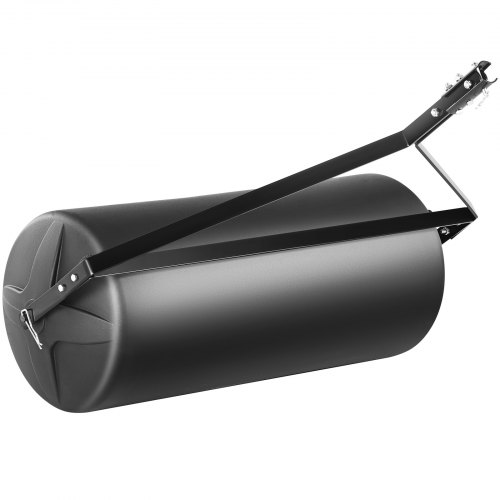
VEVOR Tow-Behind Lawn Roller (400 lb)
Open projects with an approved tow vehicle. The 400 lb product name is not a recommended operating weight. Verify what fill produces the rated weight and check towing and slope limits.
Check Price at VEVORAffiliate disclosure: we may earn a commission from these purchase links, at no extra cost to you. Prices and availability change; no live price or customer-rating feed is used here.
Should You Roll, Aerate, or Level?
Start with the problem, not the shopping cart. A hollow drum firms the surface; it does not redistribute soil or repair a drainage issue. These are different jobs with different tools.
| What you see | Is rolling useful? | Better next step |
|---|---|---|
| New seed on a prepared seedbed | A light pass can improve seed-soil contact | Prepare, seed, lightly rake as appropriate, then firm and water |
| Freshly laid sod | Yes, gentle firming can reduce air gaps | Follow the sod supplier's plan; start with a light water fill |
| Minor surface frost heave | Possibly, after thawing and drainage | Assess the surface; avoid routine heavy spring rolling |
| Hard soil, poor infiltration, thin turf | No; more pressure can worsen compaction | Consider core aeration during active grass growth |
| Low spots, ruts, or a settled trench | No; a roller cannot replace missing soil | Localized top-dressing or regrading after diagnosing the cause |
| Raised roots or recurring animal tunnels | Not a durable fix | Address the cause rather than crushing the surface |
Push vs Tow-Behind, Steel vs Poly
Operating format and drum material are separate decisions. A roller can be poly and push/tow, or steel and manual. Choose a format you can control, then choose a material you can maintain.
| Option | Why choose it | Tradeoff |
|---|---|---|
| Push/pull | Precise access around beds, gates, and smaller seed or sod jobs | You must safely control it at the intended fill; slopes are a particular concern |
| Tow-behind | Less walking on larger open projects | Requires approved towing; tractor tires can rut soft seedbeds |
| Push/tow combination | Manual access plus the option to tow on open ground | Check conversion hardware, handle storage, and rated weight |
| Poly drum | Drum will not rust; generally convenient to move empty | Protect from punctures, warping, and unsuitable fill; frame can still rust |
| Steel drum | A practical manual option with a protective coating | Coating damage and trapped moisture need attention; steel can dent |
Water vs Sand: Fill for Control, Not Maximum Weight
Water is the default for convenience. Sand is not an automatic upgrade: a roller that is harder to move and empty can be worse for both you and the lawn.
| Factor | Water | Sand |
|---|---|---|
| Adjusting weight | Easy to add and drain in small amounts | Slower to add and remove through a small opening |
| Weight estimate | About 8.34 lb per US gallon, plus the empty roller | Varies with particle size, moisture, and packing |
| Seasonal storage | Drain before freezing; dry as directed | Harder to empty; retained moisture can affect metal |
| Warranty | Often the preferred fill; check your manual | Confirm approval and damage exclusions before using |
| Best reason to choose | Temporary ballast with simple cleanup | A specific approved application, not simply a desire for more weight |
How Heavy Should a Lawn Roller Be?
There is no universal safe pound figure. Soil moisture, texture, drum width, contact area, and the job all change the result. A wider drum spreads a load differently from a narrow drum; total weight alone cannot tell you the pressure on the soil.
For freshly laid sod, University of Minnesota Extension recommends a roller about one-third full of water to improve contact beneath the sod. Use that as a light starting point for that job, then inspect a short trial pass. It is not a guarantee that every one-third-full roller is appropriate for your lawn or machine.
Estimate your roller weight
Enter your drum capacity and actual empty weight from the manual. The sample values are illustrative, not specifications for a recommended model.
60.8 lb estimated total
4.3 gallons of water adds 35.8 lb to the 25 lb empty roller.
Estimate only: empty weight + gallons of water x 8.34 lb. This is not a safe-towing rating or a soil-pressure calculation. Never exceed the roller or tow vehicle limits; the lightest effective fill is preferable.
Water ballast examples, not recommended operating weights
- 13 US gallons adds about 108 lb when completely filled, or 36 lb at one-third fill. Add the actual empty roller weight.
- 17 US gallons adds about 142 lb when completely filled, or 47 lb at one-third fill. Add the actual empty roller weight.
- 28 US gallons adds about 234 lb when completely filled, or 78 lb at one-third fill. Add the actual empty roller weight.
Read the Specs Before You Buy
Drum gallons, working width, overall dimensions, and full weight are different specifications. Overall width includes the frame and may determine whether you fit through a gate; drum width determines the rolling pass. Do not treat a listing title as a complete specification sheet.
Brinly PRC-243BH: useful cross-brand benchmark
The current manufacturer page lists a 24-inch combination push/tow poly roller, 28-gallon capacity, a published 270 lb full weight, and a 5 mph maximum towing speed. Its published overall width is about 31.31 inches, wider than the drum itself.
A scraper bar, rounded ends, a 1.625-inch fill opening, and a two-year limited warranty make this a useful comparison for drainability, access, and support. The page mixes older PRC-24BH naming with its current SKU; match the exact model and manual when ordering.
Read Brinly specifications and warranty caveatsVEVOR 17-gallon listing: a real specification conflict
The page calls the roller 17 gallons but also lists 61 liters, which is only about 16.1 US gallons. It lists an empty weight of 29.21 lb and a filled weight of 138 lb. Those figures do not reconcile with a full 17 US gallons of water.
We are not guessing which field is correct. Ask the seller for the model manual and actual capacity, and calculate towing load from verified numbers. This is why the calculator uses your own measurements instead of a hard-coded maximum weight for this model.
Check the merchant specification fieldsSize for Access and Control, Not Acreage Alone
- Small patches and narrow gates: prioritize a manually controlled roller that fits the narrowest access point, including its frame and handle. Empty weight matters when lifting it into a car or shed.
- Medium open projects: compare a larger push/pull with a push/tow combination. Being able to tow later is useful, but do not buy more ballast than you can safely control by hand.
- Large open projects: a wider tow-behind can reduce the number of passes. Check vehicle towing permission and soil firmness first; tractor tires can damage a prepared seedbed before the roller reaches it.
- Sloped or awkward terrain: do not use a heavy roller merely because the tractor can pull it uphill. Downhill braking, sideways stability, and the manufacturer's slope restrictions control the decision.
How to Roll Without Overcompacting the Lawn
The objective is contact, not a crushed seedbed or a perfectly flat established lawn. A little moisture can help firming; mud, standing water, frozen ground, and deep impressions mean wait.
- 1
Identify a job that rolling can solve
Confirm you need seed-soil contact, sod contact, or gentle correction of minor surface heave. Repair drainage, deep depressions, and roots separately.
- 2
Prepare and check the soil
Remove debris, flag sprinkler heads and obstacles, and finish grading before rolling. Wait until frozen ground thaws and saturated soil drains. Stop if footsteps leave deep impressions.
- 3
Inspect the roller and set a light fill
Check the plug seal, drum, axle, scraper, frame, and hitch. Fill with an approved material. For fresh sod, about one-third water fill is an extension-backed starting point, not a mandatory setting.
- 4
Test a short strip
Work slowly and inspect the result. You want firmer contact without rutting, soil smearing, or water being squeezed to the surface. Reduce weight or wait if the ground deforms.
- 5
Make controlled passes
Use straight passes with a small overlap and wide, gentle turns. Follow your manual's speed and slope limits. Avoid repeated passes just to chase a flatter appearance.
- 6
Finish the lawn care and store safely
Follow the seed or sod watering plan. Clean and drain the roller, let it dry, and store it securely according to the manual. Do not leave water inside through freezing weather.
A Smooth Lawn Starts With the Right Repair
A low spot needs material, a drainage problem needs a drainage solution, and root-zone compaction needs space for air and water. None of those happens simply by dragging a heavy drum across the grass.
For shallow depressions, use appropriate top-dressing without burying the grass crowns, often in stages. Deep ruts and grade problems may require lifting turf or renovating the area. Do not cut major tree roots to create a flatter lawn. If the soil is hard and infiltration is poor, investigate core aeration during active growth instead of repeatedly rolling.
Check roller vs aerator before buyingBuy or Rent? Compare the Whole Cost
For a one-time sod installation, renting may be the better purchase decision. You avoid long-term storage, cleaning between seasons, and buying a tool that is tempting to use when the lawn does not need it.
Compare a local quote including pickup, transport, rental duration, and any delivery charge against purchase price plus storage and maintenance. Buying is easier to justify when you have recurring seed or sod projects, compatible towing equipment, and room to store an empty drum.
Do not justify ownership by planning annual heavy rolling. If a roller is the right tool, choose between our small manual option and tow-behind option based on the project, not the largest advertised capacity.
Care, Storage, and Mistakes to Avoid
Drain before freezing
Water left inside can freeze and damage the drum. Drain and dry according to the manual; a roller is not a permanent ballast tank.
Protect the drum and frame
Remove mud and debris. Touch up damaged steel coatings as appropriate; a rustproof poly drum does not make a steel frame rustproof.
Keep the plug and scraper serviceable
Check the seal for leaks, keep threads clean, and inspect scraper clearance, axle hardware, and hitch fasteners before use.
Store without trapped pressure
Brinly explicitly recommends draining completely and storing with the plug removed to help prevent pressure warping. Follow the guidance for your own model.
Avoid sharp turns and unnecessary reversing
Tight turns can scuff turf. Brinly cautions that its towbar is not designed to handle a full roller in reverse; plan forward travel and wide turns.
Do not substitute improvised ballast
Concrete, gravel, antifreeze, or other unapproved fill can create damage, warranty, and environmental problems. Use the manual's approved fill.
Lawn Roller Questions, Answered
What is the best lawn roller for a small yard?
A manageable push/pull roller is generally the best fit for a small, accessible project. Our smaller affiliate option is the VEVOR 13-gallon steel roller. Choose it for maneuverability and storage, not maximum weight. A push/tow combination such as the Brinly 28-gallon poly roller is an alternative if you also want to tow it later.
Should I roll my lawn every spring?
No. An established lawn does not need an automatic annual rolling. Light rolling may help a specific surface problem such as minor frost heave after the ground has thawed and drained, but repeated heavy rolling can compact soil. New seed and freshly laid sod are more clearly defined uses.
Will a lawn roller flatten a bumpy lawn?
Not if the bumps come from roots, deep ruts, settled trenches, drainage problems, or uneven grading. A roller presses down; it cannot add missing soil or remove roots. Diagnose the cause, then use appropriate top-dressing, localized repair, or regrading instead.
How full should a lawn roller be?
Use the minimum fill that achieves the job, within the manufacturer's limits. University of Minnesota Extension recommends a roller about one-third full of water for newly laid sod. That is a starting point for sod, not a universal safe weight for every roller, soil type, or tow vehicle. Test a short strip and stop if it ruts or smears.
Is water or sand better in a lawn roller?
Water is usually the more convenient fill because it is easy to add, adjust, and drain. Sand can add more weight per volume, but its weight varies with moisture and packing and it is harder to remove. Only use a fill material approved for your model. Brinly warns that damage from non-water fill is not covered under its stated care guidance.
How much does a water-filled lawn roller weigh?
Estimate total weight as empty roller weight plus actual US gallons of water multiplied by 8.34 lb. For example, 10 gallons adds about 83.4 lb. A advertised capacity in gallons is not the roller's total filled weight. Use the calculator and confirm the manual before towing.
Can I roll a wet lawn?
Do not roll saturated, muddy, or frozen soil. If footsteps or the roller leave deep impressions, water rises to the surface, or mud builds up on the drum, wait. Slightly moist, workable soil is different from waterlogged soil; wet clay is especially vulnerable to deformation and compaction.
Should I roll after seeding or after laying sod?
Light rolling can improve seed-soil contact on a prepared seedbed and help newly laid sod contact the soil underneath. Minnesota Extension recommends both uses. It does not replace proper grading, lightly raking seed as appropriate, or watering. Avoid towing a heavy tractor across a soft new seedbed.
Is a steel or poly lawn roller better?
A poly drum will not rust and is often easier to handle empty, though its frame may still be steel. Steel is a reasonable choice for a manual roller if you can protect the coating and keep it dry. Both need leak checks and proper storage. Neither material makes excessive weight safe for turf.
Can a zero-turn mower pull a lawn roller?
Only if the mower manufacturer permits towing and the filled roller is within its attachment, hitch, load, and slope limits. A hitch alone does not prove towing is allowed. Braking and traction matter as much as the ability to pull forward. Use the manual, not engine horsepower, to decide.
Should I aerate after rolling?
Not automatically. Aeration addresses root-zone compaction, while light rolling firms the surface. If soil is already compacted, consider core aeration rather than rolling it again. Aeration timing depends on grass growth and local conditions; avoid disturbing newly installed sod before it roots.
Should I rent or buy a lawn roller?
Renting is often more sensible for a single sod or seeding project. Buying is easier to justify for recurring legitimate use when you have room to store the empty roller. Compare the complete rental cost, transport, and scheduling against the purchase price and storage burden.
How We Selected These Picks
This is a research-based buying guide, not a field test. We compared operating format, drum material, filling and drainage, published specifications, and practical limitations. University extension guidance informs the seed and sod advice. Merchant ratings, maximum weights, and product photos are not proof of better turf results. The supplied hero is an illustrative image, not documentation of a test or an endorsement by the brand shown.
Sources you can check
- University of Minnesota Extension: Seeding and sodding home lawns
Seed-soil contact, soil preparation, and a roller about one-third full of water for fresh sod.
- Brinly: PRC-243BH 28-gallon push/tow poly roller
24-inch drum, 28-gallon capacity, published 270 lb full weight, care guidance, and towing cautions.
- VEVOR: 17-gallon push/pull steel roller
Construction and handle details. Capacity and filled-weight fields conflict; see our specification caveat below.
- Bob Vila: The best lawn rollers for landscaping and yard maintenance
Comparative buying context, alternative brands, light filling, and limits of rolling an established lawn.
Related Guides
Keep going, these guides pair well with what you just read.
Lawn Roller vs Aerator
Firm the surface or relieve compaction? Choose the correct repair.
Read guideBest Tow-Behind Aerators
Compare tools for compacted soil before overseeding.
Read guideBest Lawn Spreaders
Even seed distribution, calibration, and application planning.
Read guideTow-Behind Attachment Guide
Build a practical lawn-care setup around your mower.
Read guide