
Manual vs. Powered Post Hole Digger
A clamshell digger costs little and never fails to start. A powered auger digs far faster and saves your back. The right choice comes down to how many holes you are digging, how hard your soil is, and how much you value your weekend.
Quick Answer
For a handful of holes in soft soil, a manual clamshell digger is cheaper, lighter, and completely reliable. For a fence line, deck, or repeated digging, especially in hard or rocky ground, a powered auger is worth it: electric for quiet, fuel-free work near power, gas for torque and range, or a PTO auger if you own a tractor. Count your holes and check your soil, and remember the toll on your body, then decide.
A few holes, soft soil: Manual clamshell digger
Fence line / many holes: Powered auger
Near power, lighter soil: Electric auger
Hard/rocky soil, no power: Gas auger
On this page
The 30-Second Verdict
Count the holes and feel the soil. Under about five holes in reasonable ground, a manual clamshell digger is the cheaper, simpler choice and it will never let you down. A fence line, a deck, or hard, rocky, clay soil tips the decision to a powered auger every time, and your back will thank you. If it is a one-time job, renting a gas auger for a day often beats buying. Whatever you choose, call 811 to locate utilities before you dig.
What "Manual" and "Powered" Actually Mean
Manual clamshell digger
Two hinged blades on long handles that you drive into the ground, spread, and lift to pull out a scoop of soil. Cheap, indestructible, silent, and always ready. It is pure muscle, which is fine for a few holes and punishing for many.
Powered auger
An engine or motor spins a spiral bit into the ground, from a one-person electric or gas unit up to a two-person auger or a tractor 3-point PTO auger. It digs each hole in under a minute with little effort. For the full lineup, see our post hole diggers and augers guide.
Electric vs. Gas vs. PTO Augers
Deciding to go powered is only half the choice. Match the power source to where you dig, how difficult the soil is, and whether you already own a compatible tractor.
Electric
Small projects near power
Quiet, low maintenance, and no fuel mixing. Corded models suit yards and gardens; battery models add mobility but runtime and torque vary. Best in lighter soil and for occasional holes.
Gas
Fence lines and hard soil
The most versatile handheld option: portable, strong, and available with interchangeable bits. It adds noise, fumes, fuel-system maintenance, and more kickback when a bit catches.
Tractor PTO
Many holes across acreage
The productivity choice if you own a compatible tractor. Verify PTO horsepower, three-point category, lift capacity, auger diameter, and driveline protection before buying.
Head-to-Head Comparison
| Factor | Manual Digger | Powered Auger |
|---|---|---|
| Speed per hole | Slow, one scoop at a time | Fast, bores in under a minute |
| Physical effort | Hard manual labor | The engine or motor does the digging |
| Up-front cost | $30 to $60 | $100 to $350 (electric to gas) |
| Best hole count | Up to about 5 | A fence line, deck, or more |
| Hard / rocky / clay soil | Very difficult, slow | Handles it, gas and PTO best |
| Learning curve | None, just dig | Mind kickback and controls |
| Noise & fumes | None | Gas is loud with fumes, electric quiet |
| Maintenance | None, always works | Fuel or charge, occasional service |
| Portability | Toss it in the truck | Heavier, but still one-person on handhelds |
| Toll on your body | High, blisters and back | Low, save your energy for setting posts |
Break-Even by Hole Count
Hole count is the single biggest deciding factor. Here is where most people land, adjusted down a tier if your soil is hard clay or rock.
Not worth buying or renting power. Dig by hand and move on.
A borderline call. Rent an auger for a weekend if the soil is hard.
Hand digging becomes miserable. A gas auger pays for itself in time and back.
Buy a gas auger, or run a 3-point PTO auger if you own a tractor.
The Cost Math, and Rent vs Buy
A manual digger runs about $30 to $60 and lasts forever. A one-person auger is roughly $100 to $350 (electric to gas), and a rental gas auger is often $60 to $100 for the day. That sets up a simple choice.
Rent if
- It is a one-time job like a single fence or deck
- You want a bigger auger than you would buy
- You have nowhere to store a machine
- You will not dig again for years
Buy if
- You maintain fences and animals on a property
- You will dig holes again, season after season
- You own a tractor (a PTO auger is the value play)
- Rental round-trips cost more than owning
The Hidden Cost: Your Body
The spec that never shows up on a price tag is the toll on you. One or two holes by hand is good exercise. A fence line by hand is blisters, a sore back, and a lost weekend, and it is genuinely hard on your shoulders and lower back. If you have back trouble, are older, or would rather spend that energy setting posts straight, the physical savings of a powered auger can justify it well below the pure hole-count break-even. Do not underestimate this one.
The Soil Reality Check
Soil can override hole count entirely. A manual digger flies through soft loam and stalls in dry clay, rock, and roots, where each hole can take many exhausting minutes. A powered auger, especially gas or PTO, powers through the same ground in a fraction of the time.
Before you decide, dig one test hole. If a manual digger struggles on hole number one, it will only get worse, and that alone can justify going powered even for a modest number of holes. Pre-soaking hard ground a day ahead helps either tool.
When Each One Wins
Choose a manual digger if
- You are digging about 5 holes or fewer
- Your soil is soft and workable
- You want the cheapest, simplest tool
- You value a machine that never needs fuel or service
- You want quiet work with no fumes
Choose a powered auger if
- You are digging a fence line, deck, or many holes
- Your soil is hard clay, rocky, or root-filled
- You want to save your back and your weekend
- You will dig again in future seasons
- You own a tractor (go PTO for the fastest option)
Both tools share the same first rule: call 811 a few days before you dig so buried gas, power, and water lines get marked. A manual digger has almost no mechanical risk beyond your hands and back. A powered auger digs faster but can kick back hard on roots and rock, so keep a firm two-hand grip, solid footing, and never wrap your body through the handles.
Post Hole Digger & Auger Picks
Manual clamshell, electric, and gas augers for a few holes up to a full fence line. For bit sizing, depth, and how to dig, see our full post hole diggers and augers guide.
Post Hole Diggers & Augers
Manual clamshell, electric, and gas augers for a few holes up to a full fence line.
Some links below are affiliate links, including Amazon Associate links. As an Amazon Associate, Tractor Iron earns from qualifying purchases, at no additional cost to you.

VEVOR Gas Post Hole Auger (52cc, 6" & 10" Bits)
A 52cc, 1450W one-person earth auger that ships with 6-inch and 10-inch bits plus 3 extension rods. The most versatile pick for fence posts, deck footings, and tree planting.
$150.90
Check Price at VEVOR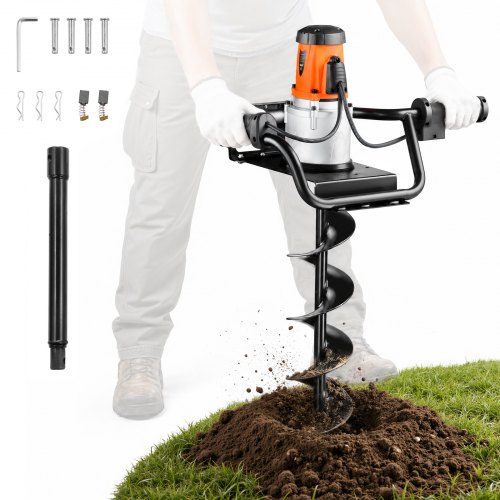
VEVOR Electric Post Hole Digger (1500W, 5.71" Bit)
A 1500W corded electric auger with a 5.71-inch bit and extension rod. Quiet, no fuel mixing, and the highest-rated powered pick. Best near power for lighter soils.
$143.91
Check Price at VEVOR
VEVOR Gas Post Hole Digger (43cc, 8" Bit)
A lighter 43cc, 1250W gas auger with an 8-inch bit and 30-inch alloy-steel flighting. The budget powered option for occasional fence and garden work.
$113.31
Check Price at VEVOR
VEVOR Manual Post Hole Digger (Carbon Steel, 57.5")
A heavy-duty clamshell digger with carbon-steel handles, scale markings, and a metal blade. The pick for a handful of holes or working where no power reaches.
$63.81
Check Price at VEVOR
VEVOR Manual Post Hole Digger (Fiberglass, 57.5")
The most affordable option, a clamshell digger with lighter fiberglass handles and scale markings. Good for light-duty and occasional post setting.
$47.79
Check Price at VEVOROwn a tractor? A PTO auger is the powered value play.
A 3-point PTO auger on a compact tractor outdigs any handheld and never tires. Browse the attachments hub to see what else your tractor can run.
Frequently Asked Questions
Is a powered auger worth it for a fence?
How many holes before a powered auger pays off?
Should I rent or buy a powered auger?
What is the difference between a post hole digger and an auger?
Can one person handle a powered auger?
Do manual diggers work in hard clay?
Is manual digging that much harder on your body?
Which is safer, manual or powered?
Sources & References
- Utility locating: Call 811, the national one-call service, before every digging project.
- Auger operation, kickback, and hole sizing: manufacturer and equipment guidance.
- Rental pricing and rent vs buy: typical equipment rental rates (verify locally).
Related Guides
Keep going, these guides pair well with what you just read.
Best Post Hole Diggers & Augers
Our top manual, electric, gas, and PTO picks with bit sizing and how-to.
Read guideTractor Attachments Hub
3-point, PTO, loader, and hydraulic implements for your tractor.
Read guideBest Sprayers for Weeds & Pasture
Keep new fence lines and pasture clear of weeds and brush.
Read guideBest Tillers & Cultivators
Prep garden and food-plot soil once the fence is in.
Read guideFarm & Property Equipment
Power, fuel, and equipment guides for running rural land.
Read guide