Best Tractors for Small Farms (2026)
Updated Feb 5, 2026
Expert guide to choosing the right tractor for your small farm. Compare 20+ models by HP, PTO power, loader capacity, and versatility for daily farm tasks from loader work to hay production.
Why Versatility Matters on Small Farms
Small farms demand versatility over specialization. Your tractor needs to switch between loader work in the morning, mowing pastures in the afternoon, and moving hay by evening. The right tractor becomes an extension of your hands—capable of handling dozens of tasks without struggling or causing frustration.
PTO HP vs Engine HP: What Really Matters
Engine HP is the marketing number; PTO HP is what drives your implements. Expect 15-20% loss from engine to PTO. A 40 HP tractor delivers roughly 32-34 PTO HP. Always check PTO HP when matching implements—your brush hog cares about PTO power, not engine power.
Loader Capability: The Most-Used Feature
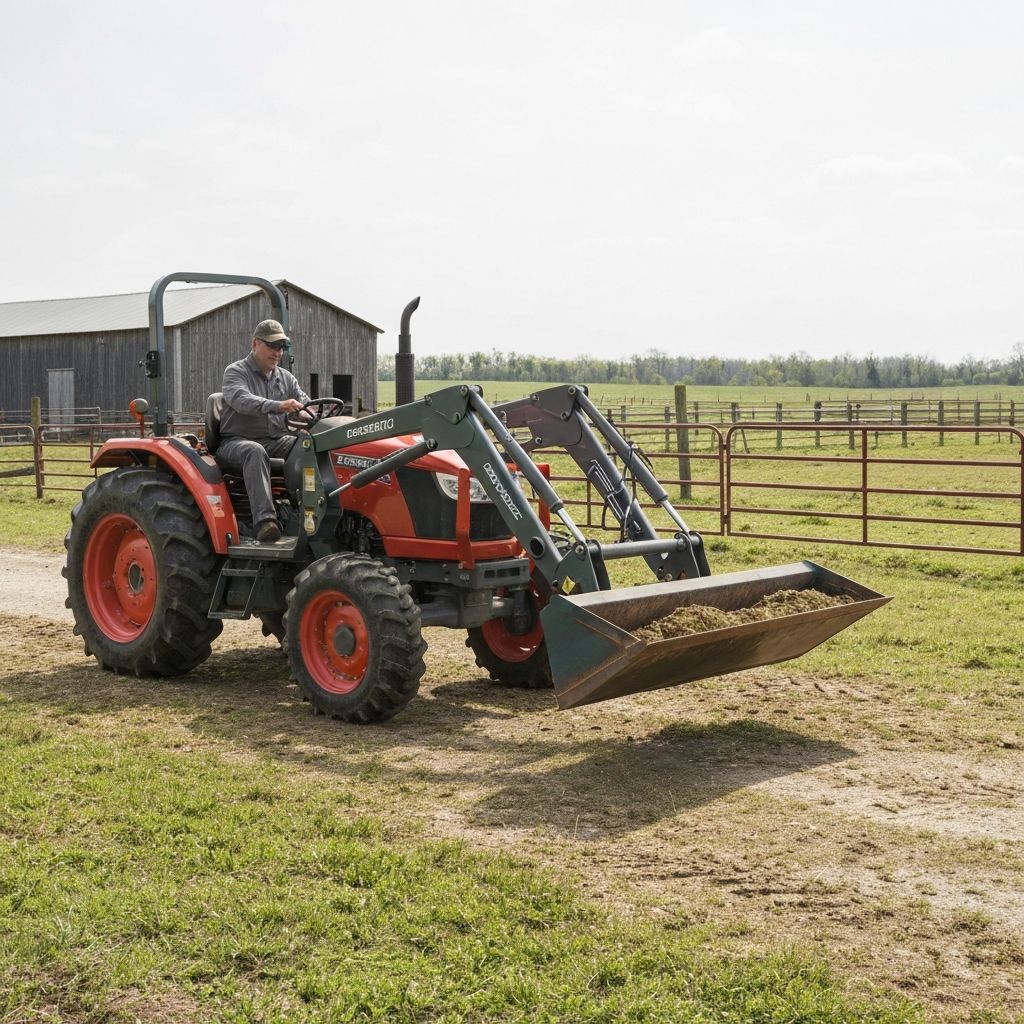
On small farms, the loader stays mounted 90%+ of the time. It handles feeding, bedding, manure, landscaping, and material moving. Prioritize lift capacity and tractor weight for stability. Under-sizing your loader capability leads to constant frustration and unsafe operations.
Daily Task Switching
Real farm work means constant task switching: loader work, mowing, grading, hauling, and seasonal hay or snow. Hydrostatic transmission handles these direction and speed changes seamlessly. Quick-attach systems for both loader and 3-point implements maximize productivity.
Tractor Weight and Stability
A heavier tractor is safer for loader work, provides better traction, and handles implements more confidently. Your tractor should weigh at least 2.5x your typical loader load. Don't sacrifice weight for "maneuverability"—a 3,000 lb tractor handles a 1,200 lb load safely; a 2,000 lb tractor does not.
4WD: Not Optional
4WD is essential for real farm work. Loader operations require front-wheel traction for steering control. Wet fields, hills, and pulling implements all demand 4WD capability. The 10-15% cost premium is insignificant compared to the capability gain. Buy 4WD from the start.
The Undersizing Regret
The most common regret among small farm owners is buying too small a tractor. Tasks take longer, implements struggle, and the tractor gets replaced within 3-5 years at additional cost. Buy for your anticipated needs 5 years out, not just today's tasks. If between two sizes, choose larger.
Small Farm Task Requirements
Different farm tasks have different requirements. Match your tractor to your most demanding task—not your lightest one. This table shows minimum specs for common small farm operations.
| Task | Min Engine HP | Min PTO HP | Min Weight | Notes |
|---|---|---|---|---|
| Loader Work (general) | 25-35 | N/A | 2,500+ lbs | Weight and lift capacity matter most; 4WD essential |
| Rotary Mowing (brush hog) | 25-40 | 20-32 | 2,200+ lbs | Match PTO HP to mower size; 5-6' mower needs 25+ PTO HP |
| Finish Mowing | 20-30 | 15-25 | 1,800+ lbs | Lower HP acceptable; focus on cut quality and ground speed |
| Snow Removal | 25-40 | 20-35 | 2,500+ lbs | Weight for traction critical; front blade or rear blower |
| Tilling / Food Plots | 25-45 | 20-35 | 2,500+ lbs | PTO HP determines tiller width; clay soil needs more power |
| Small Square Baling | 35-50 | 28-42 | 3,000+ lbs | Consistent PTO speed critical; hydro transmission helps |
| Round Baling (small) | 40-55 | 32-45 | 3,500+ lbs | More PTO demand than square baling; weight for traction |
| Post Hole Digging | 25-40 | 20-32 | 2,500+ lbs | Weight prevents lifting; rocky soil needs more torque |
Small Farm Tractor Recommendation Calculator
Answer questions about your farm and tasks to get personalized tractor recommendations. We'll calculate the right HP range, PTO power, weight, and loader capacity for your needs.
Your Farm & Tasks
Round bale: 800-1,200 lbs | Pallet of feed: 1,000-1,500 lbs | Bucket of gravel: 600-900 lbs
Your Results
Fill in your farm details and click "Calculate" to see personalized recommendations.
Small Farm Tractor Comparison Table
Compare 20 versatile small farm tractors side by side. Click column headers to sort.
| Model | HP | PTO HP | Weight | Loader | Remotes | Trans. | Class | 4WD | Best For |
|---|---|---|---|---|---|---|---|---|---|
| Kubota BX2380 | 21.6 | 16.6 | 1,477 | 680 | 1 | Hydrostatic | Sub-Compact | Small acreage, light tasks | |
| John Deere 1025R | 23.9 | 18.3 | 1,516 | 720 | 1 | Hydrostatic | Sub-Compact | Property maintenance, light farm work | |
| Yanmar SA424 | 24 | 18.5 | 2,312 | 987 | 2 | Hydrostatic | Compact | Precision farm work | |
| John Deere 3025E | 24.7 | 18.9 | 2,425 | 1,013 | 2 | Hydrostatic | Compact | All-around compact farm tractor | |
| New Holland Workmaster 25 | 24.7 | 19.2 | 2,380 | 1,012 | 2 | Hydrostatic | Compact | Reliable compact farm work | |
| Kubota L2501 | 24.8 | 19.5 | 2,535 | 1,052 | 2 | Hydrostatic | Compact | Hobby farms, versatile work | |
| Mahindra 1626 | 26.2 | 20.1 | 2,756 | 1,145 | 2 | Hydrostatic | Compact | Budget small farm tractor | |
| LS MT235E | 34.8 | 27.2 | 2,890 | 1,345 | 2 | Hydrostatic | Compact | Value farm tractor | |
| Kioti CK3510SE | 35 | 27.5 | 3,064 | 1,389 | 2 | Hydrostatic | Compact | Value compact farm tractor | |
| John Deere 3038E | 37.3 | 29.4 | 3,086 | 1,467 | 2 | Hydrostatic | Compact | Serious small farm work | |
| Mahindra 2638 | 37.4 | 30.2 | 3,450 | 1,653 | 2 | Hydrostatic | Compact | Maximum value for small farms | |
| Kubota L3901 | 37.5 | 30.8 | 3,197 | 1,433 | 2 | Hydrostatic | Compact | Heavy-duty small farm work | |
| John Deere 4044M | 43.1 | 35.8 | 4,012 | 1,812 | 2 | Hydrostatic | Compact | Premium small farm tractor | |
| Kubota L4701 | 47.3 | 39.5 | 3,902 | 1,874 | 2 | Hydrostatic | Compact | Heavy small farm operations | |
| John Deere 5055E | 55 | 45.8 | 4,630 | 2,245 | 2 | Gear/Hydro | Utility | Commercial small farm operations | |
| Case IH Farmall 55C | 55 | 45.2 | 4,523 | 2,156 | 2 | Gear/Hydro | Utility | Versatile utility farm tractor | |
| Kubota MX5400 | 55.5 | 46.3 | 4,409 | 2,178 | 3 | Hydrostatic | Utility | Larger small farms with hay | |
| Kubota M6060 | 64 | 52.8 | 5,512 | 2,687 | 3 | Gear/Hydro | Utility | Premium utility farm work | |
| Mahindra 6065 | 65 | 54.2 | 5,291 | 2,534 | 2 | Gear/Hydro | Utility | Budget utility farm tractor | |
| New Holland T4.75 | 75 | 62.5 | 5,890 | 2,845 | 3 | Gear/Hydro | Utility | Heavy-duty farm operations |
Picks by Use Case
Best Sub-Compact Farm Tractors (Under 25 HP)
For small acreages under 5 acres with light duties. Good for property maintenance but limited for serious farm work.
John Deere 1025R
Best Compact Farm Tractors (25-50 HP)
The sweet spot for most small farms. Handles loader work, mowing, light hay, and property maintenance.
John Deere 3025E
New Holland Workmaster 25
Best Utility Farm Tractors (50+ HP)
For larger small farms with serious hay production or heavy equipment needs.
Case IH Farmall 55C
Best Budget Small Farm Tractors
Value-focused brands offering strong capability at competitive prices.
Best Premium Small Farm Tractors
Top-tier machines from established brands with excellent dealer support and resale value.
Sizing, Safety, and Avoiding Regrets
The Undersizing Problem
- Most first-time buyers undersize their tractor by 20-40%
- Undersized tractors struggle with implements, take longer, and cause frustration
- Replacement within 3-5 years is common—at significant financial loss
- Buy for anticipated needs 5 years out, not just today's tasks
Weight and Stability
- Tractor weight should be 2.5x your typical loader load
- Heavier tractors are safer for loader work and pull implements better
- Add rear ballast equal to 50-75% of your typical load weight
- Don't sacrifice weight for maneuverability—you'll regret it
4WD and Transmission
- 4WD is essential for real farm work—loader ops, wet fields, hills, pulling
- Hydrostatic transmission is strongly preferred for task-switching versatility
- The premium for both is minimal compared to capability gain
When in Doubt, Go Bigger
If you're torn between two tractor sizes, choose the larger one. You'll find uses for the extra power, and you'll never wish you had less capability. The resale value of properly-sized tractors is also better than undersized ones that owners are eager to replace.
Dealer Demo Advice
Always demo tractors with your actual implements before buying. Ask to try the loader with weight, run your planned PTO equipment, and drive on terrain similar to your property. A demo reveals issues that specs cannot.
Frequently Asked Questions
What size tractor is best for a small farm?
For most small farms (5-25 acres), a compact tractor in the 25-45 HP range offers the best balance of capability and maneuverability. This size handles loader work, mowing, light tilling, and implements without being oversized. Under 5 acres, a sub-compact (18-25 HP) may suffice. Over 25 acres or with serious hay production, consider 45-65 HP utility tractors.
Is a loader necessary on a small farm?
Yes, a front-end loader is the most-used attachment on small farms. It handles feeding, bedding, manure removal, material moving, landscaping, and dozens of daily tasks. Most small farm owners report their loader stays mounted 90%+ of the time. Budget for a loader from day one—retrofitting costs more and may not match as well.
How much PTO HP do I really need?
PTO HP requirements depend on your implements. For basic mowing (brush hog, finish mower), 18-25 PTO HP is adequate. Tilling food plots or gardens needs 20-30 PTO HP. Running a small round baler requires 35-50 PTO HP. Large hay equipment needs 50+ PTO HP. Match your PTO HP to your most demanding implement, with 20% headroom.
Can one tractor handle all farm tasks?
Yes, with the right size and attachments. A 35-45 HP compact tractor with a loader, 3-point hitch, and hydrostatic transmission can handle mowing, loader work, snow removal, food plots, light hay work, and property maintenance. The key is buying enough tractor for your heaviest task—undersizing leads to frustration and eventual replacement.
What attachments should I prioritize first?
After the loader and bucket, prioritize based on your primary tasks: (1) Rotary cutter/brush hog for pasture management, (2) Box blade or land plane for grading/driveway work, (3) Post hole digger for fencing, (4) Rear blade for snow/grading. Pallet forks for the loader are also essential for moving materials, feed, and hay.
Should I buy new or used for a small farm?
Both can work well. New tractors offer warranties, latest features, and financing options but cost 40-60% more. Used compact tractors (3-7 years old) with 500-1,500 hours offer excellent value if properly maintained. Check for leaks, tire condition, 3-point operation, and loader wear. Have a mechanic inspect before buying used.
Is 4WD worth the extra cost on a small farm?
Yes, 4WD is essential for small farms. Loader work, wet conditions, hills, and pulling implements all require front-wheel traction. The 10-15% cost premium pays for itself immediately in capability. 2WD is only appropriate for flat, dry, light-duty work—rare on real farms. Buy 4WD from the start.
Hydrostatic or gear transmission for small farms?
Hydrostatic is strongly preferred for small farms. The constant direction changes and speed adjustments of loader work, mowing around obstacles, and mixed tasks favor hydrostatic's seamless control. Gear transmissions cost less but require clutching for every speed/direction change. Most small farm owners choose hydrostatic and don't regret it.
How do I avoid buying too small a tractor?
Think ahead 5 years and buy for your anticipated needs, not just today's tasks. Talk to neighbors with similar properties. Visit dealers and demo tractors with your actual implements. If choosing between two sizes, buy the larger one. The most common regret among small farm owners is undersizing their first tractor.
What's the most important spec for small farm versatility?
Operating weight is underrated but critical. A heavier tractor provides stability for loader work, traction for pulling implements, and ballast for PTO-driven equipment. Aim for a tractor weight of 2.5x your typical loader load. After weight, prioritize hydraulic capacity (remotes for rear implements) and PTO HP for your intended tasks.
Related Guides
Deep dive into loader capacity and ballast
Mowing GuideBrush hogs, finish mowers, and deck sizes
Hay Operations GuidePTO requirements for cutting and baling
Snow Removal GuideBlades, blowers, and winter prep
Food Plot GuideTilling, planting, and plot management
Browse Compact TractorsCompare all compact models
Find Dealers Near YouLocate authorized dealers
All Task-Based GuidesBrowse by your primary task
Kubota L2501 vs JD 3038EPopular compact comparison
This guide is maintained by the Tractor Iron editorial team using manufacturer specifications, dealer input, and real-world owner feedback. Specifications are verified against official sources and updated regularly. Last updated: February 5, 2026.