Utility Tractor Buying Guide (2026): Choose the Right Tractor for 5–50 Acres
Last Updated: February 2026
Last Updated: February 2026
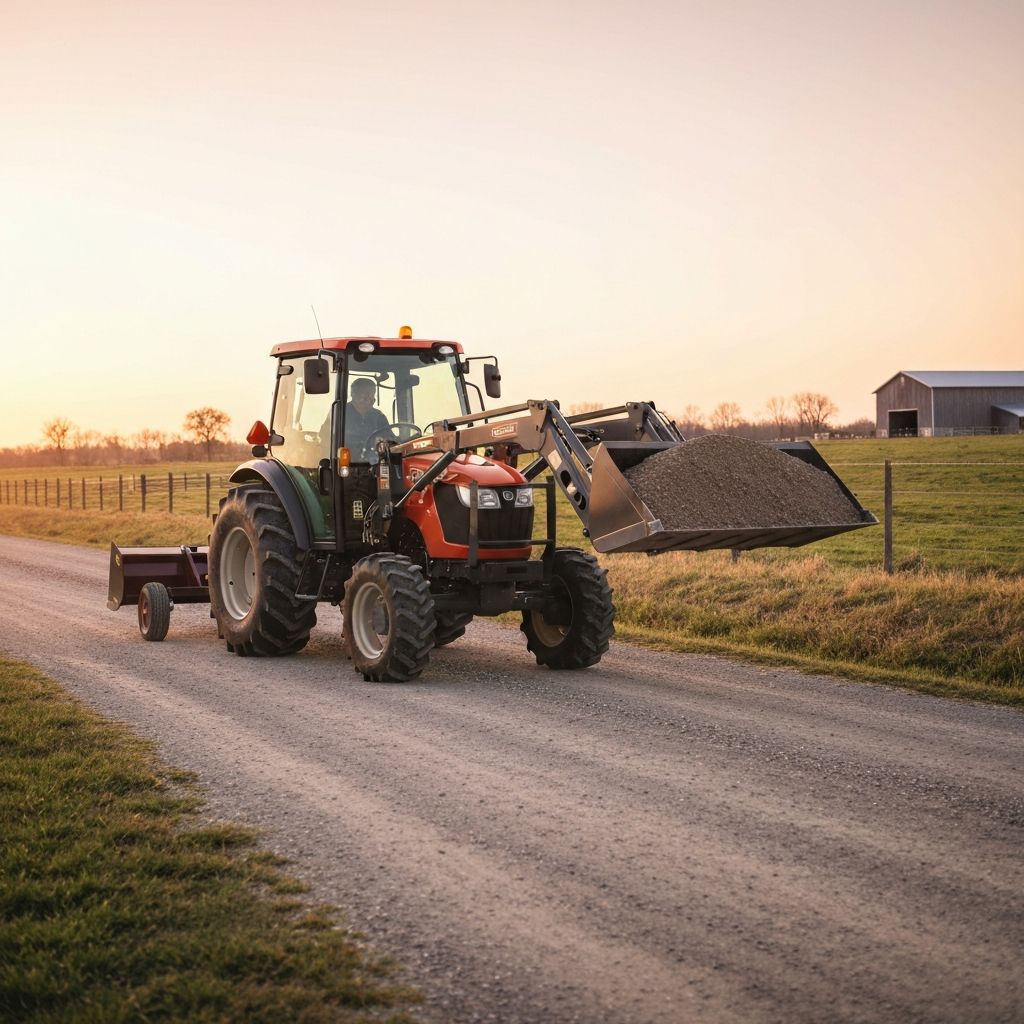
A utility tractor is a mid-size workhorse that bridges the gap between compact tractors (25–50 hp) and full-scale agricultural machines. Designed for 5 to 50+ acre properties, utility tractors deliver the horsepower, hydraulic capacity, and structural weight needed for serious loader work, wide-area mowing, tilling, hauling, snow removal, and light construction tasks that compacts simply cannot handle efficiently.
The best utility tractor buying decision comes from matching engine HP, PTO horsepower, hydraulic flow, and operating weight to your actual tasks—not brand loyalty. This comprehensive utility tractor buying guide includes jump navigation, a sortable model table sourced from our directory, an interactive picker tool, downloadable checklists, and detailed sections on every spec that matters for utility-class buyers.
Built by the Tractor Iron Home editorial team. For task-specific recommendations, see our Tractors by Task guide, our Best Tractors for Mowing page, or our Tractor Attachment Guide.
Follow these seven steps to narrow your choices before visiting a single dealer.
List your top 3-5 jobs
Mowing, loader work, grading, tilling, hauling, snow? Your task list drives every spec decision.
Use acreage + terrain to pick HP band
5-20 acres light use: 25-50 HP. 10-50 acres mixed use: 45-66 HP. 20-50+ acres heavy: 66-135 HP.
Match PTO horsepower to your primary implement
Your heaviest PTO-driven implement (rotary cutter, tiller, snowblower) dictates minimum PTO HP. Add a 10-15% margin.
Set loader + hydraulics targets
Determine minimum lift capacity, hydraulic flow (GPM), and number of remote valves for grapple or top-n-tilt.
Choose drivetrain/transmission for your work style
HST for loader/snow/versatility. Gear/power-shuttle for steady pull and PTO efficiency.
Build your starter attachment bundle
Loader bucket, box blade, pallet forks are the essential three. Add rotary cutter or snowblower based on tasks.
Compare 2-3 models with a scorecard + dealer support
Use our model table and dealer checklist below to walk into a dealership prepared.
Pro Tip
Buy a little more capability than your current needs if you expect to expand your work scope. A tractor that barely handles your heaviest task today will struggle when you add implements or acreage. Buying 10-15% more HP than your calculated minimum saves money long-term.
Safety Warning
Always wear your seatbelt with the ROPS in the upright, locked position. Never raise the loader above your line of sight when traveling. Slopes, loader height, and insufficient rear ballast are the primary causes of utility tractor rollovers. Plan ballast before your first loader use.
Utility tractors span a wide HP range. Use your acreage, terrain, and primary tasks to land in the right band.
25–50 HP
Light Utility / Compact-Utility Overlap
Lighter loader work, smaller cutters, driveway maintenance, and mowing on 5-20 acres.
45–66 HP
Common Serious Utility Zone
Heavier loader work, 5-6 ft cutters, frequent implement use, and 10-50 acre properties.
66–135 HP
Mid-Size Utility for Heavy Work
Heavy implements, serious material handling, hay equipment, and 20-50+ acre operations.
| Property Size | Typical HP Range | Best For |
|---|---|---|
| 5–20 acres | 25–50 HP | Mowing, loader, driveway work, light tilling |
| 10–50 acres | 45–66 HP | Heavier loader work, wider cutters, frequent use |
| 20–50+ acres + heavy tasks | 66–135 HP | Heavier implements, serious material handling |
Add 5–10 HP for slopes, clay soil, heavy brush cutting, or constant loader work. These conditions demand sustained power that eats into your reserve.
Understanding the typical ranges across tractor classes helps you see why utility tractors offer a significant step up in capability.
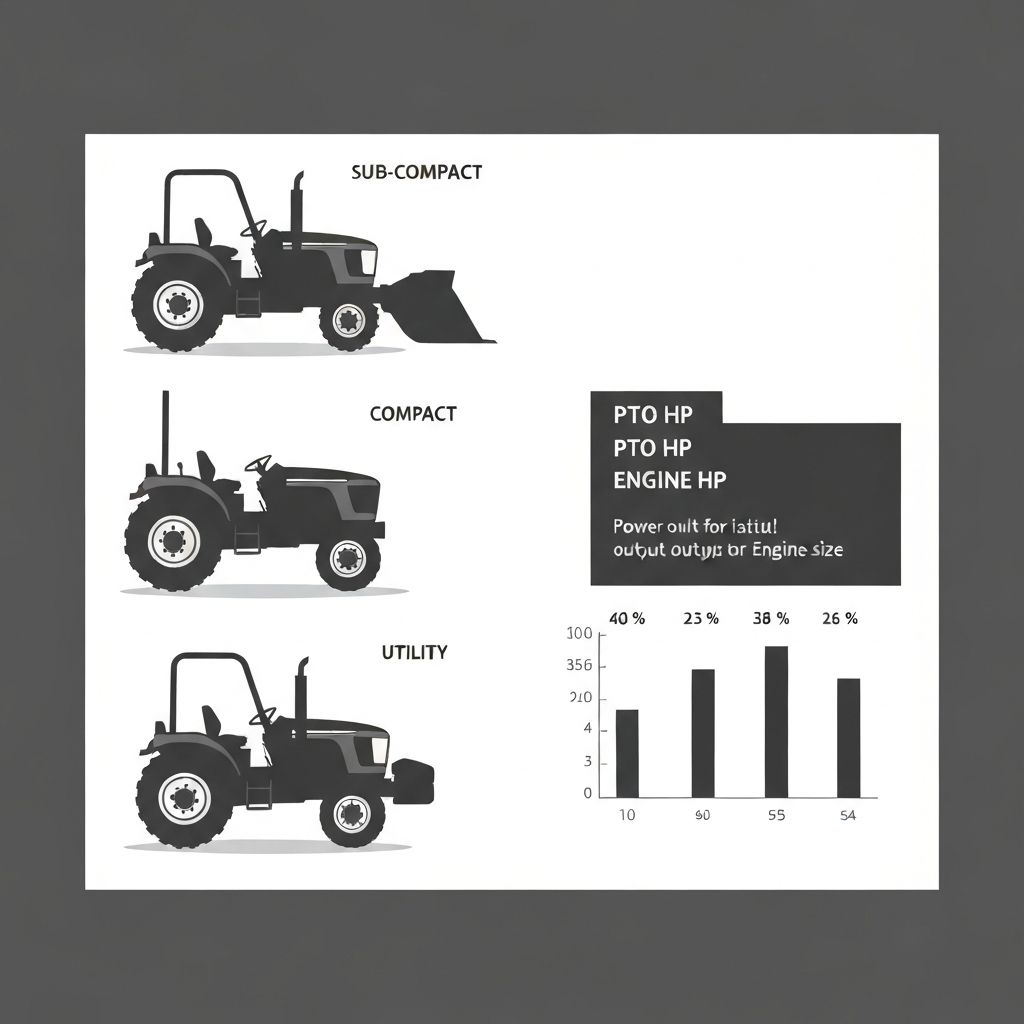
| Attribute | Sub-Compact | Compact | Mid-Size Utility |
|---|---|---|---|
| Typical Engine HP | 18–25 | 25–50 | 40–135 |
| Operating Weight | 1,200–2,000 lbs | 2,500–5,000 lbs | 4,000–10,000+ lbs |
| 3-Point Lift Capacity | 600–1,200 lbs | 1,200–2,500 lbs | 2,000–5,000+ lbs |
| Implement Width | 42–60″ | 48–72″ | 60–84″+ |
| Slope Stability | Limited | Moderate | Good–Excellent |
These are typical ranges for context, not sourced from our dataset.
Dealer brochures list dozens of numbers. These are the specs that actually determine whether a utility tractor will handle your work.
PTO HP is what actually reaches your implements after drivetrain losses (typically 15–20% less than engine HP). This is the number that determines what rotary cutters, tillers, and snowblowers you can run effectively.
| Engine HP | Typical PTO HP | Implements Supported |
|---|---|---|
| 25–45 | 20–35 | 5' rotary cutter, mid tiller, snowblower |
| 45–66 | 35–55 | 6' cutter, heavy tiller, hay tedder |
| 66–135 | 55–110 | 7'+ cutter, disc mower, large auger |
Hydraulic flow (GPM) determines loader cycle speed and steering response. Pressure (PSI) determines maximum lifting force. Both matter for productive loader work on utility tractors.
Utility tractors typically deliver 8–20+ GPM and 2,000–3,000 PSI. Higher GPM = faster loader; higher PSI = stronger lift. Target 12+ GPM for serious loader use.
Utility tractors typically use Category I/II or Category II hitches, supporting heavier rear implements than compacts. Lift capacity determines what box blades, tillers, and hay equipment you can raise and transport.
Typical utility range: 2,000–5,000+ lbs. Ensure capacity exceeds your heaviest implement by at least 20%.
Heavier tractors provide better loader stability and traction but compact soil more. A longer wheelbase dramatically improves slope safety. Always check operating weight and wheelbase when comparing utility models.
4WD is strongly recommended for all utility tractor use—the traction benefit on slopes, wet ground, and loader work is critical at this weight class.
Utility tractors are significantly larger than compacts. Measure your barn doors, gate openings, and storage bays before purchasing. A cab adds 6–12 inches of height. A loader adds width. Always verify overall dimensions with the loader and largest implement attached.
The front-end loader is the single most-used attachment on utility tractors. Your hydraulic system's flow and pressure determine how productive your loader work will be. See our Tractor Attachment Guide for detailed implement matching.
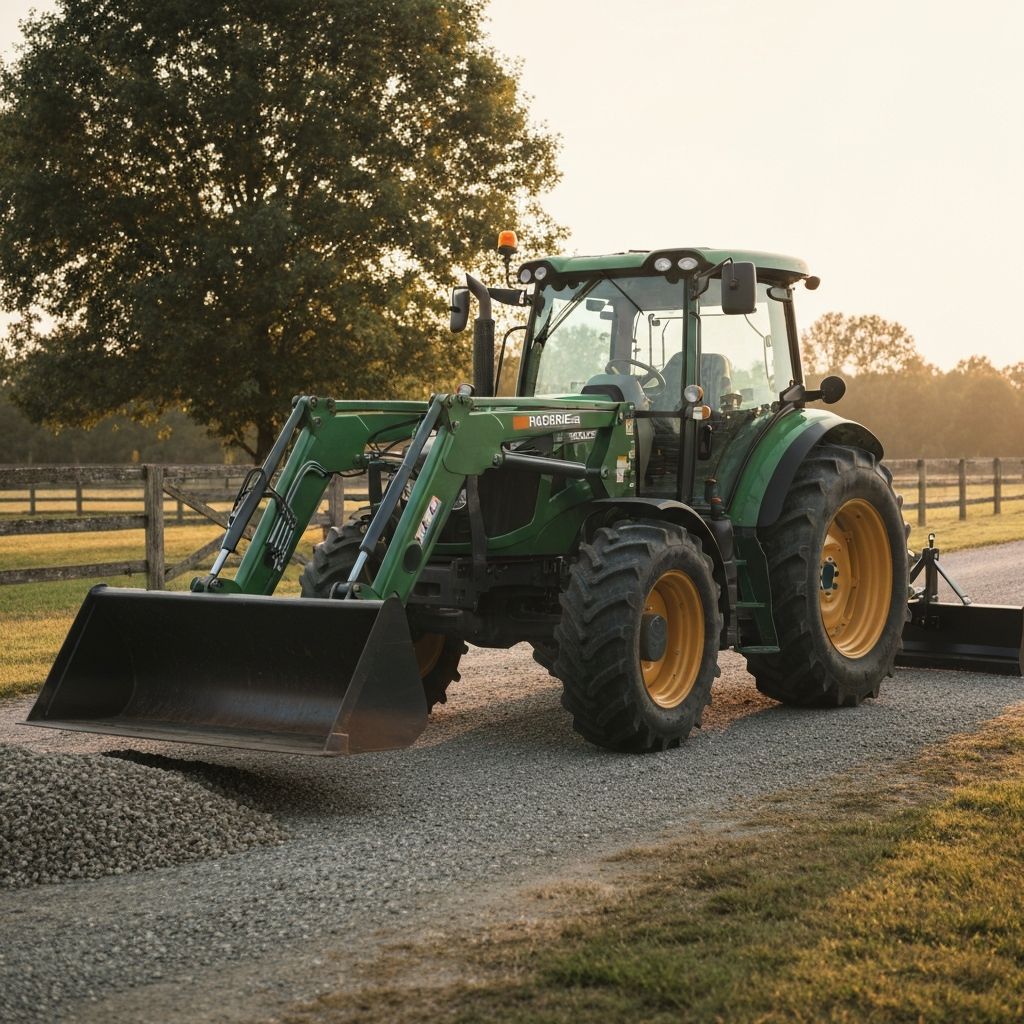
Hydraulic flow (GPM) directly affects how fast your loader raises, curls, and dumps. Low GPM means slow, frustrating loader cycles. Utility tractors typically offer 8–20+ GPM; target 12+ GPM for dedicated loader work and 15+ GPM if running grapple or top-n-tilt attachments.
Hydraulic pressure (PSI) determines the maximum force your cylinders can exert. Higher PSI means stronger breakout force when digging and greater lift capacity. Most utility tractors deliver 2,000–3,000 PSI. Do not compare GPM without also comparing PSI—both together determine loader performance.
Remote valves allow you to power hydraulic attachments beyond the basic loader functions. A grapple requires a third-function valve; top-n-tilt requires a fourth. Check that your utility tractor has 2–3 remote valves or offers them as a factory option. Aftermarket kits are available but add cost and complexity.
A loaded loader bucket with no rear counterweight will lift your rear wheels off the ground, causing loss of steering and potential rollover. Always have a heavy rear implement (box blade), loaded rear tires, or a dedicated ballast box when using the loader. Plan ballast as part of the purchase, not an afterthought.
Transmission choice significantly impacts daily productivity. Most utility buyers choose HST for versatility, but gear/power-shuttle excels at steady pull work.
| Factor | HST Best For | Gear/Shuttle Best For |
|---|---|---|
| Primary tasks | Loader / snow / grading | Tilling / mowing / steady pull |
| Terrain | Mixed / varies | Open field / steady work |
| Operator experience | All levels | Experienced |
| Fuel efficiency | Lower under heavy load | Higher mechanical transfer |
| Loader productivity | Excellent | Adequate with shuttle |
Your property's terrain and the implements you plan to run directly impact the weight, HP, and drivetrain requirements.
Slopes demand weight, a long wheelbase, 4WD, and adequate rear ballast. Utility tractors have a significant stability advantage over compacts on slopes due to their heavier operating weight. Always keep the loader low, travel straight up and down (never across), and never exceed 15-degree grades.
Heavy brush cutting requires significant PTO horsepower and tractor weight to keep ground speed steady through thick material. A 6–7 ft rotary cutter in dense brush may need 45–65 PTO HP. Lighter tractors will stall or bounce; heavier utility models maintain cutting momentum.
Rocky and clay soils increase implement demand significantly. Tilling in clay requires 30–50% more PTO power than in loamy soil. Rocky conditions wear implements faster and require heavier tractor frames to absorb shock. R4 or Ag tires provide critical traction in these conditions.
A tractor is only as useful as its implements. See our full Tractor Attachment Guide for detailed compatibility information.
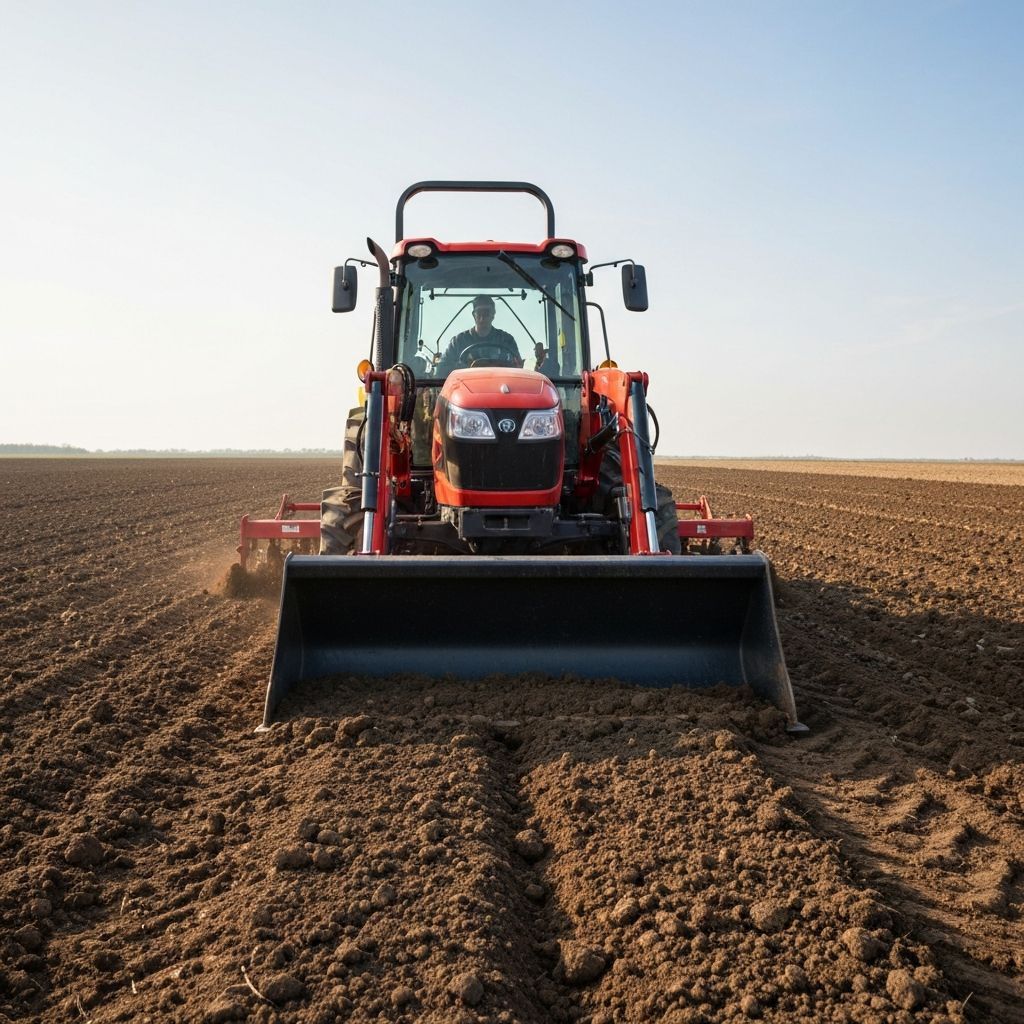
See Best Tractors for Mowing for detailed mowing guidance.
Both new and used utility tractors can be excellent purchases. The key is understanding the trade-offs.
| Factor | New | Used |
|---|---|---|
| Price | Full MSRP | 30–50% less |
| Warranty | Full manufacturer (2–6 yr powertrain) | None or limited (dealer-certified) |
| Maintenance history | Known (zero hours) | Depends on records |
| Downtime risk | Low | Higher without inspection |
| Financing | Manufacturer rates available | Higher rates, shorter terms |
| Best for | Primary machine, warranty peace of mind | Budget-conscious, experienced buyers |
Use this checklist when inspecting any used utility tractor. It covers every critical system and includes walk-away red flags.
If you encounter any of these issues, seriously reconsider the purchase or walk away entirely:
Understanding common repair cost ranges helps you evaluate whether a used tractor's lower price is truly a bargain after potential repair bills.
| Repair Category | Typical Range (Parts + Labor) | Severity |
|---|---|---|
| Hydraulic hose / seal replacement | $100–$300 | Minor |
| Hydraulic pump rebuild | $800–$2,500 | Moderate |
| Loader cylinder reseal / rebuild | $200–$600 per cylinder | Moderate |
| PTO clutch replacement | $500–$1,500 | Moderate |
| Transmission overhaul | $2,000–$6,000+ | Major |
| Engine overhaul | $3,000–$8,000+ | Major |
Ranges vary significantly by model, labor rates, and parts availability. Always get a pre-purchase inspection on high-hour used tractors.
Total ownership cost includes more than the purchase price. Plan for fuel, routine maintenance, and eventual major service.
< 200 hours/year
$300–$800/yr
Oil changes, filters, grease, fluid checks. DIY-friendly maintenance for weekend use.
200–500 hours/year
$800–$1,500/yr
Regular service intervals plus tire wear, hydraulic maintenance, and occasional belt/hose replacement.
500+ hours/year
$1,500–$3,000+/yr
Full-service intervals, accelerated wear items, potential major service. Dealer service adds labor premium.
John Deere 5065E
3.2 GPH
John Deere 5075E
3.7 GPH
John Deere 5100E
5 GPH
John Deere 5105M
5.2 GPH
John Deere 5120M
6 GPH
Mahindra 6065 4WD
4 GPH
| 10-Year Cost Category | Routine | Major |
|---|---|---|
| Oil, filters, grease | Ongoing (every 100–200 hrs) | — |
| Hydraulic fluid/filter | Every 500–1,000 hrs | — |
| Tire replacement | — | Every 2,000–4,000 hrs |
| Transmission service | — | 1,500–3,000+ hrs |
| Engine overhaul | — | 5,000–8,000+ hrs (if needed) |
Proactive maintenance significantly extends intervals and reduces the probability of major repairs.
A tractor without nearby dealer support is a liability during your busiest seasons. Find Dealers Near You to check coverage for the brands you are considering.
Print this checklist and bring it to the dealership. It ensures you ask the right questions and compare models consistently.
All models below are sourced from our directory with category "Utility".Sort by any column, filter by multiple criteria, and export the data. 547 models available.
| Satisfaction | Value | ||||||||||
|---|---|---|---|---|---|---|---|---|---|---|---|
| Antonio Carraro MACH 4 TONY | 74.2 | N/A | Mechanical-Hydrostatic Hybrid | 4WD | N/A | N/A | 7,275 lbs | $66,500 | 8.0/10 | 8.0/10 | 7.0/10 |
| Antonio Carraro SRG 7600 infinity | 75.3 | N/A | Hydrostatic | 4WD | N/A | 5,071 lbs | 5,776 lbs | $58,500 | 8.0/10 | 8.0/10 | 7.0/10 |
| Antonio Carraro TGF 8900 R Ergit R | 74.2 | N/A | Mechanical | 4WD | N/A | 5,291 lbs | 4,916 lbs | $70,000 | 8.5/10 | 8.5/10 | 7.5/10 |
| Antonio Carraro TONY 8700 V | 75.3 | N/A | Mechanical-Hydrostatic Hybrid | 4WD | N/A | N/A | 5,567 lbs | $73,000 | 8.0/10 | 8.0/10 | 7.0/10 |
| Antonio Carraro TONY 8900 TRG | 74.2 | N/A | CVT Hydrostatic | 4WD | N/A | 5,291 lbs | 5,049 lbs | $77,500 | 8.5/10 | 8.5/10 | 7.5/10 |
| Bobcat AT450 Diesel | 24.8 | N/A | Hydrostatic | 4WD | N/A | N/A | 1,865 lbs | $32,000+ | 7.9/10 | 7.8/10 | 7.6/10 |
| Bobcat AT450 Gas | 32.5 | N/A | Hydrostatic | 4WD | N/A | N/A | 1,860 lbs | $28,000+ | 7.8/10 | 7.7/10 | 7.5/10 |
| Bobcat UT6066 | 66.4 | 57.4 | Powershuttle 12x12 | 4WD | 17.9 | 3,594 lbs | 5,440 lbs | $48,000+ | 8.6/10 | 8.6/10 | 8.4/10 |
| Bobcat UT6566 | 66.4 | 54 | Gear | 4WD | 17.4 | 4,850 lbs | 5,830 lbs | $52,000+ | 8.0/10 | 8.0/10 | 7.7/10 |
| Bobcat UT6573 | 73.1 | 60 | Gear | 4WD | 17.4 | 5,070 lbs | 5,960 lbs | $58,000+ | 8.1/10 | 8.1/10 | 7.7/10 |
| Branson 6640C | 66 | 57 | Gear | 4WD | 11.1 | 4,800 lbs | 5,825 lbs | $55,000+ | 7.6/10 | 7.6/10 | 8.0/10 |
| Branson 7845C | 78 | 64 | Gear | 4WD | 12.4 | 5,000 lbs | 6,250 lbs | $65,000+ | 7.6/10 | 7.8/10 | 8.0/10 |
| Branson 7845R | 78 | 64 | Gear | 4WD | 12.4 | 5,000 lbs | 5,752 lbs | $62,000+ | 7.6/10 | 7.8/10 | 8.2/10 |
| Branson 8050 | 78 | 65 | Gear | 4WD | 14.5 | 5,000 lbs | 7,910 lbs | $70,000+ | 7.6/10 | 7.6/10 | 8.0/10 |
| Case IH AFS Connect Puma 185 | 185 | N/A | N/A | N/A | N/A | N/A | N/A | $210,000+ | N/A | N/A | N/A |
| Case IH AFS Connect Puma 200 | 200 | N/A | N/A | N/A | N/A | N/A | N/A | $225,000+ | N/A | N/A | N/A |
| Case IH AFS Connect Puma 220 | 220 | N/A | N/A | N/A | N/A | N/A | N/A | $240,000+ | N/A | N/A | N/A |
| Case IH AFS Connect Puma 240 | 240 | N/A | N/A | N/A | N/A | N/A | N/A | $260,000+ | N/A | N/A | N/A |
| Case IH AFS Connect Puma 260 | 260 | N/A | N/A | N/A | N/A | N/A | N/A | $285,000+ | N/A | N/A | N/A |
| Case IH Farmall 100C | 99 | 85 | Power Shuttle | 4WD | 16.9 | 5,620 lbs | 7,573 lbs | $71,000–$89,000 | 8.4/10 | 8.2/10 | 8.0/10 |
| Case IH Farmall 100CL | 100 | N/A | N/A | N/A | N/A | N/A | N/A | $72,000+ | N/A | N/A | N/A |
| Case IH Farmall 100N | 100 | N/A | N/A | N/A | N/A | N/A | N/A | $60,000+ | N/A | N/A | N/A |
| Case IH Farmall 105A | 112 | 92 | Power Shuttle | 4WD | 16.9 | 7,716 lbs | 7,898 lbs | $73,000–$91,000 | 8.6/10 | 8.4/10 | 8.2/10 |
| Case IH Farmall 110A Pro | 110 | N/A | N/A | N/A | N/A | N/A | N/A | $75,000+ | N/A | N/A | N/A |
| Case IH Farmall 110C | 107 | 93 | Power Shuttle | 4WD | 16.9 | 5,620 lbs | 8,157 lbs | $75,000–$95,000 | 8.1/10 | 8.0/10 | 7.8/10 |
| Case IH Farmall 110CL | 110 | N/A | N/A | N/A | N/A | N/A | N/A | $78,000+ | N/A | N/A | N/A |
| Case IH Farmall 110M | 110 | N/A | N/A | N/A | N/A | N/A | N/A | $82,000+ | N/A | N/A | N/A |
| Case IH Farmall 110N | 110 | N/A | N/A | N/A | N/A | N/A | N/A | $65,000+ | N/A | N/A | N/A |
| Case IH Farmall 110U | 110 | N/A | N/A | N/A | N/A | N/A | N/A | $80,000+ | N/A | N/A | N/A |
| Case IH Farmall 110V | 110 | N/A | N/A | N/A | N/A | N/A | N/A | $62,000+ | N/A | N/A | N/A |
| Case IH Farmall 115A | 120 | 100 | Power Shuttle | 4WD | 21.6 | 7,716 lbs | 8,492 lbs | $81,000–$101,000 | 8.6/10 | 8.4/10 | 8.2/10 |
| Case IH Farmall 120 Super M | 120 | N/A | N/A | N/A | N/A | N/A | N/A | $95,000+ | N/A | N/A | N/A |
| Case IH Farmall 120A | 118 | 96 | Power Shuttle | 4WD | 22 | 7,200 lbs | 9,524 lbs | $70,200 | 8.5/10 | 8.8/10 | 7.5/10 |
| Case IH Farmall 120C | 120 | N/A | N/A | N/A | N/A | N/A | N/A | $90,000+ | N/A | N/A | N/A |
| Case IH Farmall 120CL | 120 | N/A | N/A | N/A | N/A | N/A | N/A | $85,000+ | N/A | N/A | N/A |
| Case IH Farmall 120N | 120 | N/A | N/A | N/A | N/A | N/A | N/A | $72,000+ | N/A | N/A | N/A |
| Case IH Farmall 120U | 120 | N/A | N/A | N/A | N/A | N/A | N/A | $88,000+ | N/A | N/A | N/A |
| Case IH Farmall 130A Pro | 130 | N/A | N/A | N/A | N/A | N/A | N/A | $85,000+ | N/A | N/A | N/A |
| Case IH Farmall 140A Pro | 140 | N/A | N/A | N/A | N/A | N/A | N/A | $92,000+ | N/A | N/A | N/A |
| Case IH Farmall 40C | 40.2 | 32.4 | Hydrostatic | 4WD | 8.2 | 2,469 lbs | 3,869 lbs | $32,423 | 8.2/10 | 8.2/10 | 7.7/10 |
| Case IH Farmall 55A | 54 | 43 | Power Shuttle | 4WD | 12.6 | 5,952 lbs | 6,228 lbs | $41,000–$51,000 | 8.4/10 | 8.4/10 | 8.2/10 |
| Case IH Farmall 55C | 55 | 46.7 | Hydrostatic | 4WD | 8.2 | 2,469 lbs | 3,770 lbs | $53,405 | 8.3/10 | 8.3/10 | 7.8/10 |
| Case IH Farmall 60A | 60 | N/A | N/A | N/A | N/A | N/A | N/A | $45,000+ | N/A | N/A | N/A |
| Case IH Farmall 65A | 64 | 51 | Power Shuttle | 4WD | 12.6 | 5,952 lbs | 6,228 lbs | $49,000–$61,000 | 8.4/10 | 8.4/10 | 8.2/10 |
| Case IH Farmall 65C | 64 | 50 | Power Shuttle | 4WD | 12.8 | 3,960 lbs | 6,272 lbs | $51,000–$63,000 | 8.4/10 | 8.2/10 | 8.0/10 |
| Case IH Farmall 70A | 70 | N/A | N/A | N/A | N/A | N/A | N/A | $48,000+ | N/A | N/A | N/A |
| Case IH Farmall 75A | 74 | 60 | Power Shuttle | 4WD | 12.6 | 5,952 lbs | 6,834 lbs | $55,000–$69,000 | 8.4/10 | 8.4/10 | 8.2/10 |
| Case IH Farmall 75C | 76 | 62 | Power Shuttle | 4WD | 12.8 | 3,960 lbs | 6,768 lbs | $45,360 | 8.4/10 | 8.4/10 | 7.9/10 |
| Case IH Farmall 80CL | 80 | N/A | N/A | N/A | N/A | N/A | N/A | $58,000+ | N/A | N/A | N/A |
| Case IH Farmall 80N | 80 | N/A | N/A | N/A | N/A | N/A | N/A | $50,000+ | N/A | N/A | N/A |
| Case IH Farmall 80V | 80 | N/A | N/A | N/A | N/A | N/A | N/A | $52,000+ | N/A | N/A | N/A |
| Case IH Farmall 90C | 86 | 73 | Power Shuttle | 4WD | 16.9 | 5,620 lbs | 7,573 lbs | $65,000–$81,000 | 8.4/10 | 8.2/10 | 8.0/10 |
| Case IH Farmall 90CL | 90 | N/A | N/A | N/A | N/A | N/A | N/A | $65,000+ | N/A | N/A | N/A |
| Case IH Farmall 90N | 90 | N/A | N/A | N/A | N/A | N/A | N/A | $55,000+ | N/A | N/A | N/A |
| Case IH Farmall 95A | 97 | 78 | Power Shuttle | 4WD | 16.9 | 7,716 lbs | 7,898 lbs | $67,000–$83,000 | 8.6/10 | 8.4/10 | 8.2/10 |
| Case IH Farmall 95C | 95 | 80 | Power Shuttle | 4WD | 16.1 | 3,960 lbs | 8,115 lbs | $47,384 | 8.4/10 | 8.4/10 | 7.9/10 |
| Case IH Farmall Utility 100A | 100 | N/A | N/A | N/A | N/A | N/A | N/A | $72,000+ | N/A | N/A | N/A |
| Case IH Farmall Utility 110A | 110 | N/A | N/A | N/A | N/A | N/A | N/A | $78,000+ | N/A | N/A | N/A |
| Case IH Farmall Utility 90A | 90 | N/A | N/A | N/A | N/A | N/A | N/A | $68,000+ | N/A | N/A | N/A |
| Case IH Magnum 200 | 200 | 170 | Powershift | 4WD | 54 | 19,900 lbs | N/A | $214,000–$264,000 | 8.4/10 | 8.2/10 | 7.6/10 |
| Case IH Magnum 220 | 220 | 185 | Powershift | 4WD | 54 | 19,900 lbs | N/A | $234,000–$289,000 | 8.4/10 | 8.2/10 | 7.6/10 |
| Case IH Magnum 240 | 240 | 205 | Powershift | 4WD | 54 | 19,900 lbs | N/A | $257,000–$314,000 | 8.4/10 | 8.2/10 | 7.6/10 |
| Case IH Magnum 265 | 265 | 218 | Powershift | 4WD | 67 | 19,900 lbs | N/A | $281,000–$344,000 | 8.4/10 | 8.2/10 | 7.6/10 |
| Case IH Magnum 280 | 280 | 235 | Full Powershift | 4WD | 44 | 12,900 lbs | 28,600 lbs | $271,106 | 8.8/10 | 8.8/10 | 7.5/10 |
| Case IH Magnum 295 | 295 | 248 | Powershift | 4WD | 67 | 19,900 lbs | N/A | $311,000–$379,000 | 8.4/10 | 8.2/10 | 7.6/10 |
| Case IH Magnum 310 | 310 | 265 | Powershift | MFWD | 44 | 15,900 lbs | 28,800 lbs | $275,312 | 8.9/10 | 8.8/10 | 7.5/10 |
| Case IH Magnum 325 | 325 | 277 | Powershift | 4WD | 59 | 15,900 lbs | 28,800 lbs | $549,000–$588,000 | 8.4/10 | 8.2/10 | 7.6/10 |
| Case IH Magnum 340 | 340 | 290 | Powershift | MFWD | 44 | 17,400 lbs | 28,230 lbs | $302,400 | 9.0/10 | 8.9/10 | 7.5/10 |
| Case IH Magnum 355 | 355 | 303 | Powershift | 4WD | 59 | 19,900 lbs | 32,200 lbs | $570,000–$625,000 | 8.4/10 | 8.2/10 | 7.5/10 |
| Case IH Magnum 385 | 385 | 320 | CVT | 4WD | 59 | 19,900 lbs | 32,200 lbs | $600,000–$660,000 | 8.4/10 | 8.2/10 | 7.5/10 |
| Case IH Magnum 405 | 405 | 352 | Powershift | 4WD | 59 | 19,900 lbs | 32,200 lbs | $620,000–$690,000 | 8.4/10 | 8.2/10 | 7.5/10 |
| Case IH Maxxum 115 | 116 | 95 | Semi-Powershift | 4WD | 16.6 | 7,509 lbs | 10,900 lbs | $59,341 | 8.6/10 | 8.8/10 | 7.5/10 |
| Case IH Maxxum 125 | 125 | 105 | Semi-Powershift | 4WD | 31.9 | 8,945 lbs | N/A | $104,000–$127,000 | 8.8/10 | 8.6/10 | 8.0/10 |
| Case IH Maxxum 135 | 135 | 110 | Semi-Powershift | 4WD | 31.9 | 8,945 lbs | N/A | $111,000–$137,000 | 8.8/10 | 8.6/10 | 8.0/10 |
| Case IH Maxxum 145 | 145 | 120 | Semi-Powershift | 4WD | 21.1 | 6,200 lbs | 12,555 lbs | $129,174 | 8.7/10 | 8.8/10 | 7.5/10 |
| Case IH Maxxum 150 | 150 | 125 | Semi-Powershift | 4WD | 39.6 | 8,945 lbs | N/A | $121,000–$149,000 | 8.8/10 | 8.6/10 | 8.0/10 |
| Case IH Optum 270 | 271 | 240 | CVT | 4WD | 43.6 | 22,705 lbs | N/A | $234,000–$284,000 | 8.6/10 | 8.2/10 | 7.6/10 |
| Case IH Optum 300 | 300 | 267 | CVT | 4WD | 43.6 | 22,705 lbs | N/A | $254,000–$309,000 | 8.6/10 | 8.2/10 | 7.6/10 |
| Case IH Optum 340 | 340 | 282 | CVT | 4WD | 43.6 | 22,705 lbs | N/A | $274,000–$334,000 | 8.6/10 | 8.2/10 | 7.6/10 |
| Case IH Optum 360 | 360 | 300 | CVT | 4WD | 58 | 25,926 lbs | N/A | $294,000–$359,000 | 8.6/10 | 8.2/10 | 7.6/10 |
| Case IH Optum 390 | 390 | 325 | CVT | 4WD | 58 | 25,926 lbs | N/A | $319,000–$389,000 | 8.6/10 | 8.2/10 | 7.6/10 |
| Case IH Optum 440 | 440 | 370 | CVT | 4WD | 58 | 25,926 lbs | N/A | $349,000–$424,000 | 8.6/10 | 8.2/10 | 7.6/10 |
| Case IH Puma 150 | 150 | 125 | Powershift | 4WD | 45 | 15,432 lbs | N/A | $144,000–$174,000 | 8.6/10 | 8.4/10 | 7.8/10 |
| Case IH Puma 165 | 165 | 140 | Powershift | 4WD | 45 | 15,432 lbs | N/A | $154,000–$187,000 | 8.6/10 | 8.4/10 | 7.8/10 |
| Case IH Puma 175 | 175 | N/A | N/A | N/A | N/A | N/A | N/A | $185,000+ | N/A | N/A | N/A |
| Case IH Puma 185 | 185 | 150 | Powershift | 4WD | 45 | 15,432 lbs | N/A | $167,000–$204,000 | 8.6/10 | 8.4/10 | 7.8/10 |
| Case IH Puma 200 | 200 | 170 | Powershift | 4WD | 45 | 15,432 lbs | N/A | $181,000–$221,000 | 8.6/10 | 8.4/10 | 7.8/10 |
| Case IH Puma 220 | 220 | 190 | Powershift | 4WD | 45 | 15,432 lbs | N/A | $197,000–$241,000 | 8.6/10 | 8.4/10 | 7.8/10 |
| Case IH Puma 240 | 240 | 210 | Powershift | 4WD | 45 | 15,432 lbs | N/A | $214,000–$264,000 | 8.6/10 | 8.4/10 | 7.8/10 |
| Case IH Steiger 425 | 425 | 360 | Powershift | 4WD | 95 | 22,000 lbs | N/A | $415,000–$515,000 | 8.4/10 | 8.0/10 | 7.4/10 |
| Case IH Steiger 475 | 475 | 405 | Powershift | 4WD | 95 | 22,000 lbs | N/A | $455,000–$565,000 | 8.4/10 | 8.0/10 | 7.4/10 |
| Case IH Steiger 525 | 525 | 450 | Powershift | 4WD | 113 | 22,000 lbs | N/A | $490,000–$605,000 | 8.4/10 | 8.0/10 | 7.4/10 |
| Case IH Steiger 555 | 555 | 475 | Powershift | 4WD | 113 | 22,000 lbs | N/A | $520,000–$645,000 | 8.4/10 | 8.0/10 | 7.4/10 |
| Case IH Steiger 595 | 595 | 510 | Powershift | 4WD | 113 | 22,000 lbs | N/A | $555,000–$690,000 | 8.4/10 | 8.0/10 | 7.4/10 |
| Case IH Steiger 645 | 645 | 555 | Powershift | 4WD | 113 | 22,000 lbs | N/A | $595,000–$740,000 | 8.4/10 | 8.0/10 | 7.4/10 |
| Case IH Steiger 715 | 715 | 620 | Powershift | 4WD | 113 | 22,000 lbs | N/A | $645,000–$805,000 | 8.4/10 | 8.0/10 | 7.4/10 |
| Case IH Steiger 785 | 785 | 680 | Powershift | 4WD | 113 | 22,000 lbs | N/A | $705,000–$875,000 | 8.4/10 | 8.0/10 | 7.4/10 |
| Case IH Vestrum 100 | 100 | 76 | CVT | 4WD | 28.5 | 6,700 lbs | N/A | $94,000–$117,000 | 8.6/10 | 8.4/10 | 7.8/10 |
| Case IH Vestrum 110 | 110 | 88 | CVT | 4WD | 28.5 | 6,700 lbs | N/A | $102,000–$127,000 | 8.6/10 | 8.4/10 | 7.8/10 |
| Case IH Vestrum 120 | 120 | 102 | CVT | 4WD | 28.5 | 6,700 lbs | N/A | $111,000–$137,000 | 8.6/10 | 8.4/10 | 7.8/10 |
| Case IH Vestrum 130 | 130 | 111 | CVT | 4WD | 28.5 | 6,700 lbs | N/A | $121,000–$149,000 | 8.6/10 | 8.4/10 | 7.8/10 |
| CLAAS ARION 630 CMATIC | 165 | N/A | CVT | 4WD | N/A | N/A | N/A | $260,000–$290,000 | 8.5/10 | 8.4/10 | 8.3/10 |
| CLAAS ARION 650 CMATIC | 185 | N/A | CVT | 4WD | N/A | N/A | N/A | $280,000–$300,000 | 8.6/10 | 8.5/10 | 8.3/10 |
| CLAAS ARION 660 CMATIC | 205 | N/A | CVT | 4WD | N/A | N/A | N/A | $300,000–$320,000 | 8.6/10 | 8.6/10 | 8.3/10 |
| CLAAS AXION 820 CMATIC | 215 | N/A | CVT | 4WD | N/A | N/A | N/A | $300,000–$340,000 | 8.6/10 | 8.5/10 | 8.2/10 |
| CLAAS AXION 840 CMATIC | 235 | N/A | CVT | 4WD | N/A | N/A | N/A | $320,000–$370,000 | 8.6/10 | 8.6/10 | 8.2/10 |
| CLAAS AXION 860 CMATIC | 264 | N/A | CVT | 4WD | N/A | N/A | N/A | $350,000–$400,000 | 8.7/10 | 8.6/10 | 8.2/10 |
| CLAAS AXION 880 CMATIC | 295 | N/A | CVT | 4WD | N/A | N/A | N/A | $380,000–$420,000 | 8.7/10 | 8.7/10 | 8.2/10 |
| CLAAS AXION 930 | 355 | N/A | CVT | 4WD | N/A | N/A | N/A | $650,000–$720,000 | 8.7/10 | 8.7/10 | 8.2/10 |
| CLAAS AXION 930 TERRA TRAC | 355 | N/A | CVT | Half-Track 4WD | N/A | N/A | N/A | $670,000–$740,000 | 9.0/10 | 8.8/10 | 8.2/10 |
| CLAAS AXION 960 | 445 | N/A | CVT | 4WD | N/A | N/A | N/A | $700,000–$750,000 | 8.8/10 | 8.8/10 | 8.2/10 |
| CLAAS AXION 960 TERRA TRAC | 445 | N/A | CVT | Half-Track 4WD | N/A | N/A | N/A | $720,000–$780,000 | 9.0/10 | 9.0/10 | 8.2/10 |
| CLAAS XERION 12.590 TERRA TRAC | 585 | N/A | CVT | Half-Track 4WD | N/A | N/A | N/A | $730,000–$760,000 | 9.0/10 | 8.8/10 | 8.0/10 |
| CLAAS XERION 12.590 TRAC | 585 | N/A | CVT | All-Wheel Steer 4WD | N/A | N/A | N/A | $730,000–$760,000 | 9.0/10 | 8.8/10 | 8.0/10 |
| CLAAS XERION 12.650 TERRA TRAC | 653 | N/A | CVT | Half-Track 4WD | N/A | N/A | N/A | $760,000–$785,000 | 9.0/10 | 9.0/10 | 8.0/10 |
| CLAAS XERION 12.650 TRAC | 653 | N/A | CVT | All-Wheel Steer 4WD | N/A | N/A | N/A | $760,000–$785,000 | 9.0/10 | 9.0/10 | 8.0/10 |
| CLAAS XERION 4500 TRAC | 490 | N/A | CVT | All-Wheel Steer 4WD | N/A | N/A | N/A | $300,000–$350,000 | 8.8/10 | 8.7/10 | 8.0/10 |
| CLAAS XERION 4500 TRAC VC | 490 | N/A | CVT | All-Wheel Steer 4WD | N/A | N/A | N/A | $320,000–$370,000 | 8.8/10 | 8.7/10 | 8.0/10 |
| CLAAS XERION 5000 TRAC | 530 | N/A | CVT | All-Wheel Steer 4WD | N/A | N/A | N/A | $320,000–$380,000 | 8.8/10 | 8.8/10 | 8.0/10 |
| CLAAS XERION 5000 TRAC VC | 530 | N/A | CVT | All-Wheel Steer 4WD | N/A | N/A | N/A | $340,000–$400,000 | 8.8/10 | 8.8/10 | 8.0/10 |
| Deutz-Fahr 4065 | 65 | N/A | Synchronized Shuttle | 4WD | 13.2 | 5,500 lbs | N/A | $35,000–$50,000 | 8.6/10 | 8.6/10 | 9.0/10 |
| Deutz-Fahr 4080 GS | 80 | N/A | Power Shuttle | 4WD | 13.2 | 5,500 lbs | N/A | $45,000–$65,000 | 8.6/10 | 8.6/10 | 8.8/10 |
| Deutz-Fahr 5080 DF | 75 | N/A | Powershift | 4WD | 17 | 6,150 lbs | N/A | $55,000–$75,000 | 8.6/10 | 8.6/10 | 8.6/10 |
| Deutz-Fahr 5080 DV | 75 | N/A | Powershift | 4WD | 17 | 6,150 lbs | N/A | $55,000–$75,000 | 8.6/10 | 8.6/10 | 8.6/10 |
| Deutz-Fahr 5080D | 80 | N/A | Synchronized Shuttle | 4WD | 13.2 | 5,500 lbs | N/A | $40,000–$55,000 | 8.6/10 | 8.6/10 | 8.8/10 |
| Deutz-Fahr 5080G TB | 75 | N/A | Power Shuttle | 4WD | 14.9 | 7,900 lbs | N/A | $50,000–$70,000 | 8.6/10 | 8.6/10 | 8.6/10 |
| Deutz-Fahr 5100D | 102 | N/A | Synchronized Shuttle | 4WD | 13.2 | 5,500 lbs | N/A | $45,000–$60,000 | 8.6/10 | 8.6/10 | 8.8/10 |
| Deutz-Fahr 5105 | 106 | N/A | Power Shuttle | 4WD | 14.5 | 11,925 lbs | N/A | $65,000–$85,000 | 8.8/10 | 8.6/10 | 8.6/10 |
| Deutz-Fahr 5115 DF | 113 | N/A | Powershift | 4WD | 17 | 6,150 lbs | N/A | $70,000–$95,000 | 8.6/10 | 8.6/10 | 8.6/10 |
| Deutz-Fahr 5115 DV | 113 | N/A | Powershift | 4WD | 17 | 6,150 lbs | N/A | $70,000–$95,000 | 8.6/10 | 8.6/10 | 8.6/10 |
| Deutz-Fahr 5115G TB | 116 | N/A | Power Shuttle | 4WD | 14.9 | 7,900 lbs | N/A | $60,000–$80,000 | 8.6/10 | 8.6/10 | 8.6/10 |
| Deutz-Fahr 5125 | 126 | N/A | Power Shuttle | 4WD | 14.5 | 11,925 lbs | N/A | $75,000–$95,000 | 8.8/10 | 8.6/10 | 8.6/10 |
| Deutz-Fahr 6135C RV Shift | 136 | N/A | Powershift | 4WD | 32 | 15,400 lbs | N/A | $95,000–$120,000 | 8.8/10 | 8.8/10 | 8.6/10 |
| Deutz-Fahr 6135C TTV | 136 | N/A | CVT | 4WD | 32 | 15,400 lbs | N/A | $110,000–$140,000 | 9.0/10 | 8.8/10 | 8.4/10 |
| Deutz-Fahr 6155 | 156 | N/A | Powershift | 4WD | 45 | 22,025 lbs | N/A | $110,000–$135,000 | 9.0/10 | 8.8/10 | 8.4/10 |
| Deutz-Fahr 6155 TTV | 156 | N/A | CVT | 4WD | 45 | 22,025 lbs | N/A | $130,000–$160,000 | 9.2/10 | 9.0/10 | 8.4/10 |
| Deutz-Fahr 6175 | 176 | N/A | Powershift | 4WD | 45 | 22,025 lbs | N/A | $120,000–$145,000 | 9.0/10 | 8.8/10 | 8.4/10 |
| Deutz-Fahr 6175 TTV | 176 | N/A | CVT | 4WD | 45 | 22,025 lbs | N/A | $140,000–$175,000 | 9.2/10 | 9.0/10 | 8.4/10 |
| Deutz-Fahr 6215 | 212 | N/A | Powershift | 4WD | 45 | 22,025 lbs | N/A | $140,000–$170,000 | 9.0/10 | 8.8/10 | 8.4/10 |
| Deutz-Fahr 6215 TTV | 212 | N/A | CVT | 4WD | 45 | 22,025 lbs | N/A | $160,000–$200,000 | 9.2/10 | 9.0/10 | 8.2/10 |
| Deutz-Fahr 7250 TTV | 246 | N/A | CVT | 4WD | 32 | 22,050 lbs | N/A | $240,000–$340,000 | 9.2/10 | 9.0/10 | 8.2/10 |
| Deutz-Fahr 80F Keyline | 80 | N/A | Synchronized Shuttle | 4WD | N/A | N/A | N/A | $40,000–$60,000 | 8.6/10 | 8.6/10 | 8.8/10 |
| Deutz-Fahr 8280 TTV | 287 | N/A | CVT | 4WD | 55 | 24,471 lbs | N/A | $230,000–$280,000 | 9.2/10 | 9.0/10 | 8.0/10 |
| Deutz-Fahr 9340 TTV | 336 | N/A | CVT | 4WD | 55 | 26,450 lbs | N/A | $350,000–$400,000 | 9.2/10 | 9.0/10 | 8.0/10 |
| Fendt 1050 Vario | 500 | 450 | CVT | 4WD | 43.6 | 27,000 lbs | 30,865 lbs | $735,000 | 8.6/10 | 8.8/10 | 6.8/10 |
| Fendt 314 Vario | 130 | 110 | CVT | 4WD | 22.2 | 13,140 lbs | 11,045 lbs | $185,000 | 8.6/10 | 8.6/10 | 7.4/10 |
| Fendt 512 Vario | 122 | 105 | CVT | 4WD | 19.8 | 17,152 lbs | 13,338 lbs | $215,000 | 8.6/10 | 8.8/10 | 7.4/10 |
| Fendt 516 Vario | 161 | 140 | CVT | 4WD | 19.8 | 17,152 lbs | 14,110 lbs | $235,000 | 8.6/10 | 8.8/10 | 7.4/10 |
| Fendt 618 Vario | 204 | 175 | CVT | 4WD | 40.2 | N/A | 16,711 lbs | $290,000 | 8.4/10 | 8.4/10 | 7.0/10 |
| Fendt 720 Vario | 203 | 175 | CVT | 4WD | 43.6 | 17,637 lbs | 20,400 lbs | $320,000 | 8.8/10 | 9.0/10 | 7.2/10 |
| Fendt 724 Vario | 243 | 205 | CVT | 4WD | 43.6 | 17,637 lbs | 20,800 lbs | $350,000 | 8.8/10 | 9.0/10 | 7.2/10 |
| Fendt 728 Vario | 276 | 245 | CVT | 4WD | 43.6 | 24,840 lbs | 21,275 lbs | $415,000 | 8.8/10 | 9.0/10 | 7.2/10 |
| Fendt 936 Vario | 355 | 300 | CVT | 4WD | 42.3 | 19,800 lbs | 22,840 lbs | $500,000 | 8.8/10 | 9.0/10 | 7.0/10 |
| Fendt 942 Vario | 415 | 341 | CVT | 4WD | 43.6 | 27,898 lbs | 25,970 lbs | $560,000 | 8.8/10 | 9.0/10 | 7.0/10 |
| John Deere 5050E | 50 | 37 | Gear | 2WD | 18.2 | 3,192 lbs | 5,335 lbs | $36,500–$45,500 | 8.5/10 | 8.5/10 | 7.5/10 |
| John Deere 5060E | 60 | 46 | Gear | 2WD | 18.2 | 3,192 lbs | 5,445 lbs | $41,500–$51,500 | 8.5/10 | 8.5/10 | 7.5/10 |
| John Deere 5065E | 65 | 53 | Synchro Shuttle | 4WD | N/A | N/A | 5,070 lbs | $48,100 | 9.2/10 | 9.0/10 | 8.8/10 |
| John Deere 5067E | 67 | 53 | Gear | 2WD | 18.2 | 3,192 lbs | 5,555 lbs | $44,500–$55,500 | 8.5/10 | 8.5/10 | 7.5/10 |
| John Deere 5075E | 75 | 60 | Manual | 4WD | 18.2 | 3,192 lbs | 5,555 lbs | $55,000 | 8.6/10 | 9.1/10 | 7.6/10 |
| John Deere 5075M | 75 | 57.7 | PowrReverser | 4WD | 18.4 | 5,150 lbs | 8,765 lbs | $57,500–$71,500 | 8.6/10 | 8.6/10 | 7.4/10 |
| John Deere 5085M | 85 | 70 | PowrReverser | 4WD | 24.7 | 5,150 lbs | 8,765 lbs | $64,500–$81,500 | 8.6/10 | 8.6/10 | 7.4/10 |
| John Deere 5090E | 90 | 75 | Gear | 4WD | 22.5 | 4,600 lbs | 7,275 lbs | $55,500–$69,500 | 8.5/10 | 8.5/10 | 7.4/10 |
| John Deere 5095M | 95 | 80 | PowrReverser | 4WD | 24.7 | 5,150 lbs | 8,765 lbs | $72,500–$91,500 | 8.6/10 | 8.6/10 | 7.3/10 |
| John Deere 5100E | 100 | 85 | PowrReverser | 4WD | 22.5 | 4,600 lbs | 7,275 lbs | $59,000 | 8.6/10 | 8.4/10 | 7.6/10 |
| John Deere 5105M | 105 | 90 | PowrReverser | 4WD | 24.7 | 5,150 lbs | 8,765 lbs | $63,500 | 8.6/10 | 8.4/10 | 7.6/10 |
| John Deere 5120M | 120 | 105 | PowrReverser | 4WD | 24.7 | 5,150 lbs | 8,765 lbs | $66,500 | 9.2/10 | 9.1/10 | 8.9/10 |
| John Deere 5130M | 130 | 115 | PowrQuad PLUS | 4WD | 25.6 | 6,975 lbs | 8,740 lbs | $94,500–$119,500 | 8.6/10 | 8.6/10 | 7.3/10 |
| John Deere 6105E | 105 | 84.7 | PowrReverser | 4WD | N/A | N/A | 10,240 lbs | $70,000 | 8.6/10 | 8.4/10 | 7.6/10 |
| John Deere 6120E | 120 | 96.8 | PowrReverser | 4WD | N/A | N/A | 10,240 lbs | $74,000 | 8.6/10 | 8.4/10 | 7.6/10 |
| John Deere 6M 105 | 103.3 | 79 | Power Shift | 4WD | 21 | 6,057 lbs | 13,393 lbs | $148,161–$148,161 | 8.8/10 | 8.8/10 | 7.0/10 |
| John Deere 6M 115 | 114 | 88 | Power Shift | 4WD | 21 | 6,057 lbs | 13,393 lbs | $157,502–$157,502 | 8.8/10 | 8.8/10 | 7.0/10 |
| John Deere 6M 125 | 123.4 | 97 | Power Shift | 4WD | 21 | 6,057 lbs | 13,393 lbs | $166,069–$166,069 | 8.8/10 | 8.8/10 | 7.0/10 |
| John Deere 6M 130 | 128.7 | 100 | Power Shift | 4WD | 21 | 7,930 lbs | 13,779 lbs | $172,884–$172,884 | 8.8/10 | 8.8/10 | 7.0/10 |
| John Deere 6M 140 | 140 | 121 | Manual | 4WD | N/A | 7,930 lbs | 13,889 lbs | $132,500 | 9.0/10 | 8.8/10 | 8.0/10 |
| John Deere 6M 145 | 143.5 | 111 | Power Shift | 4WD | 30 | 7,709 lbs | 17,416 lbs | $204,061–$204,061 | 8.8/10 | 8.8/10 | 6.9/10 |
| John Deere 6M 150 | 147.5 | 120 | IVT | 4WD | 30 | 7,930 lbs | 13,779 lbs | $190,000–$210,000 | 8.8/10 | 8.8/10 | 6.9/10 |
| John Deere 6M 155 | 152.9 | 120 | Power Shift | 4WD | 30 | 7,709 lbs | 17,416 lbs | $213,462–$213,462 | 8.8/10 | 8.8/10 | 6.9/10 |
| John Deere 6M 165 | 162.3 | 125 | Power Shift | 4WD | 30 | 7,709 lbs | 17,416 lbs | $221,446–$221,446 | 8.8/10 | 8.8/10 | 6.9/10 |
| John Deere 6M 180 | 180 | 156 | Manual | 4WD | N/A | 10,132 lbs | 19,180 lbs | $165,000 | 9.0/10 | 8.8/10 | 8.0/10 |
| John Deere 6M 185 | 182.4 | 146 | IVT | 4WD | 30 | 7,709 lbs | 17,416 lbs | $220,000–$250,000 | 8.8/10 | 8.8/10 | 6.9/10 |
| John Deere 6M 200 | 197.1 | 159 | Power Shift | 4WD | 30 | 10,132 lbs | 18,959 lbs | $255,797–$255,797 | 8.8/10 | 8.8/10 | 6.9/10 |
| John Deere 6M 220 | 217.3 | 177 | Power Shift | 4WD | 30 | 10,132 lbs | 18,959 lbs | $271,426–$271,426 | 8.8/10 | 8.8/10 | 6.9/10 |
| John Deere 6M 230 | 266.6 | 184 | IVT | 4WD | 41 | 12,996 lbs | 19,951 lbs | $311,278–$311,278 | 8.8/10 | 8.8/10 | 6.9/10 |
| John Deere 6M 240 | 237.4 | 194 | IVT | 4WD | 30 | 10,132 lbs | 18,959 lbs | $270,000–$310,000 | 8.8/10 | 8.8/10 | 6.9/10 |
| John Deere 6M 250 | 246.8 | 195 | IVT | 4WD | 41 | 12,996 lbs | 19,951 lbs | $328,766–$328,766 | 8.8/10 | 8.8/10 | 6.9/10 |
| John Deere 6M 95 | 93.9 | 70 | Power Shift | 4WD | 21 | 6,057 lbs | 13,393 lbs | $139,532–$139,532 | 8.8/10 | 8.8/10 | 7.0/10 |
| John Deere 6R 110 | 108.6 | 83 | Power Shift | 4WD | 30 | 7,937 lbs | 13,228 lbs | $200,000–$215,000 | 8.9/10 | 8.9/10 | 7.0/10 |
| John Deere 6R 120 | 118 | 91 | Power Shift | 4WD | 30 | 7,937 lbs | 13,448 lbs | $211,615–$211,615 | 8.9/10 | 8.9/10 | 7.0/10 |
| John Deere 6R 130 | 128.7 | 101 | Power Shift | 4WD | 30 | 7,937 lbs | 13,668 lbs | $230,000–$250,000 | 8.9/10 | 8.9/10 | 7.0/10 |
| John Deere 6R 140 | 140 | 121 | AutoQuad/IVT | 4WD | N/A | N/A | 13,668 lbs | $150,000 | 9.0/10 | 8.8/10 | 8.0/10 |
| John Deere 6R 145 | 144.8 | 113 | Power Shift | 4WD | 30 | 9,193 lbs | 15,212 lbs | $260,000–$290,000 | 8.9/10 | 8.9/10 | 7.0/10 |
| John Deere 6R 155 | 152.9 | 122 | Power Shift | 4WD | 30 | 9,193 lbs | 15,653 lbs | $280,000–$310,000 | 8.9/10 | 8.9/10 | 6.9/10 |
| John Deere 6R 165 | 162.3 | 129 | IVT | 4WD | 30 | 9,193 lbs | 15,653 lbs | $300,000–$330,000 | 8.9/10 | 8.9/10 | 6.9/10 |
| John Deere 6R 175 | 173 | 137 | Power Shift | 4WD | 41 | 9,480 lbs | 18,298 lbs | $320,000–$350,000 | 8.9/10 | 8.9/10 | 6.9/10 |
| John Deere 6R 195 | 195 | 169 | CVT | 4WD | N/A | 9,480 lbs | 18,519 lbs | $195,000 | 9.0/10 | 8.8/10 | 8.0/10 |
| John Deere 6R 215 | 211.9 | 174 | Power Shift | 4WD | 41 | 11,990 lbs | 18,739 lbs | $360,000–$420,000 | 8.9/10 | 8.9/10 | 6.9/10 |
| John Deere 6R 230 | 226.6 | 209 | IVT | 4WD | 42.3 | 15,430 lbs | 20,503 lbs | $343,578 | 8.9/10 | 8.9/10 | 6.9/10 |
| John Deere 6R 250 | 246.8 | 229 | IVT | 4WD | 42.3 | 15,430 lbs | 21,270 lbs | $360,359 | 8.9/10 | 8.9/10 | 6.9/10 |
| John Deere 7R 210 | 210 | 170 | Power Shift | 4WD | 43 | 15,200 lbs | N/A | $226,000–$339,000 | 9.0/10 | 9.0/10 | 6.8/10 |
| John Deere 7R 230 | 230 | 189 | Power Shift | 4WD | 43 | 15,200 lbs | N/A | $260,000–$360,000 | 9.0/10 | 9.0/10 | 6.8/10 |
| John Deere 7R 250 | 250 | 205 | Power Shift | 4WD | 43 | 15,200 lbs | N/A | $278,374 | 9.0/10 | 9.0/10 | 6.8/10 |
| John Deere 7R 270 | 270 | 224 | Power Shift | 4WD | 43 | 15,200 lbs | N/A | $289,932 | 9.0/10 | 9.0/10 | 6.8/10 |
| John Deere 7R 290 | 290 | 242 | Power Shift | 4WD | 43 | 15,200 lbs | N/A | $301,491 | 9.0/10 | 9.0/10 | 6.8/10 |
| John Deere 7R 310 | 310 | 260 | Power Shift | 4WD | 43 | 15,200 lbs | N/A | $313,050 | 9.0/10 | 9.0/10 | 6.7/10 |
| John Deere 7R 330 | 330 | 260 | Power Shift | 4WD | 43 | 15,200 lbs | N/A | $324,608 | 9.0/10 | 9.0/10 | 6.7/10 |
| John Deere 7R 350 | 350 | 260 | Power Shift | 4WD | 43 | 15,200 lbs | N/A | $400,000–$500,000 | 9.0/10 | 9.0/10 | 6.7/10 |
| John Deere 8245R | 245 | 196.5 | PowerShift | 4WD | N/A | N/A | 25,868 lbs | $430,000 | 9.2/10 | 9.2/10 | 9.0/10 |
| John Deere 8270R | 270 | 216.8 | PowerShift | 4WD | N/A | N/A | 27,553 lbs | $450,000 | 8.6/10 | 9.2/10 | 7.6/10 |
| John Deere 8295R | 295 | 235.8 | PowerShift | 4WD | N/A | N/A | 27,553 lbs | $470,000 | 8.6/10 | 8.4/10 | 7.6/10 |
| John Deere 8320R | 320 | 36.7 | PowerShift | 4WD | N/A | N/A | 32,691 lbs | $490,000 | 8.6/10 | 9.2/10 | 7.6/10 |
| John Deere 8R 230 | 230 | 182 | Power Shift | 4WD | 60 | 15,200 lbs | 27,800 lbs | $283,001 | 9.0/10 | 9.0/10 | 6.8/10 |
| John Deere 8R 250 | 250 | 200 | Power Shift | 4WD | 60 | 15,200 lbs | 27,800 lbs | $299,109 | 9.0/10 | 9.0/10 | 6.8/10 |
| John Deere 8R 280 | 280 | 228 | Power Shift | 4WD | 60 | 15,200 lbs | 27,800 lbs | $323,262 | 9.0/10 | 9.0/10 | 6.7/10 |
| John Deere 8R 310 | 310 | 257 | Power Shift | 4WD | 60 | 20,000 lbs | 27,800 lbs | $385,695 | 9.0/10 | 9.0/10 | 6.7/10 |
| John Deere 8R 340 | 340 | 284 | Power Shift | 4WD | 60 | 20,000 lbs | 27,800 lbs | $408,496 | 9.0/10 | 9.0/10 | 6.7/10 |
| John Deere 8R 370 | 370 | 310 | Power Shift | 4WD | 60 | 20,000 lbs | 27,800 lbs | $432,652 | 9.0/10 | 9.0/10 | 6.6/10 |
| John Deere 8R 410 | 410 | 310 | Power Shift | 4WD | 60 | 20,000 lbs | 27,800 lbs | $462,726 | 9.0/10 | 9.0/10 | 6.6/10 |
| Kioti CK4010 | 39.6 | 34.9 | Gear | 4WD | 11.7 | 1,631 lbs | 2,679 lbs | $24,840 | 8.0/10 | 8.1/10 | 8.6/10 |
| Kioti DK5010 | 50 | 45.6 | shuttle | 4WD | 14.7 | 3,307 lbs | 3,373 lbs | $37,800 | 8.1/10 | 8.3/10 | 8.7/10 |
| Kioti DK6010 | 57.7 | 52.8 | Hydrostatic | 4WD | 14.7 | 3,307 lbs | 3,523 lbs | $45,360 | 8.2/10 | 8.4/10 | 8.8/10 |
| Kioti HX1151 | 115 | 83.9 | Power Shuttle | 4WD | 32 | 8,002 lbs | 10,230 lbs | $85,967 | 8.1/10 | 8.3/10 | 8.4/10 |
| Kioti HX1301 | 130 | 109 | Power Shuttle | 4WD | 43.7 | 10,697 lbs | 10,700 lbs | $100,000 | 8.2/10 | 8.4/10 | 8.5/10 |
| Kioti HX1302 | 130.1 | 109 | Power Shuttle Semi-Powershift | 4WD | 44.1 | 8,492 lbs | 11,660 lbs | $107,918+ | 8.0/10 | 8.2/10 | 8.2/10 |
| Kioti HX1401 | 140 | 120 | Power Shuttle | 4WD | 43.7 | 10,697 lbs | 10,700 lbs | $110,000 | 8.2/10 | 8.4/10 | 8.5/10 |
| Kioti HX1402 | 140.1 | 120 | Power Shuttle Semi-Powershift | 4WD | 44.1 | 8,492 lbs | 11,660 lbs | $117,284+ | 8.0/10 | 8.2/10 | 8.2/10 |
| Kioti HX9010 | 90 | 70 | Power Shuttle | 4WD | 32 | 8,002 lbs | 10,230 lbs | $77,728 | 8.0/10 | 8.2/10 | 8.3/10 |
| Kioti NS4710 | 44.9 | 36.6 | Shuttle / Hydrostatic | 4WD | 16.5 | 2,493 lbs | 4,027 lbs | $32,038 | 8.1/10 | 8.2/10 | 8.5/10 |
| Kioti NS4710 CAB | 44.9 | 36.6 | Synchro Shuttle | 4WD | 16.5 | 2,940 lbs | 4,614 lbs | $40,176+ | 8.4/10 | 8.4/10 | 8.6/10 |
| Kioti NS4710H | 44.9 | 36.6 | HST | 4WD | 16.5 | 2,493 lbs | 4,027 lbs | $34,837+ | 8.4/10 | 8.4/10 | 8.6/10 |
| Kioti NS4710H CAB | 44.9 | 36.3 | HST | 4WD | 16.5 | 2,940 lbs | 4,422 lbs | $42,975+ | 8.4/10 | 8.4/10 | 8.6/10 |
| Kioti NS5310 | 50.3 | 41.8 | Hydrostatic | 4WD | 16.5 | 2,493 lbs | 4,027 lbs | $37,205 | 8.2/10 | 8.3/10 | 8.5/10 |
| Kioti NS5310H | 50.3 | 36.6 | HST | 4WD | 16.5 | 2,940 lbs | 4,027 lbs | $37,205+ | 8.4/10 | 8.4/10 | 8.6/10 |
| Kioti NS6010 | 57.7 | 48.3 | Shuttle / Hydrostatic | 4WD | 16.5 | 2,493 lbs | 4,027 lbs | $40,403 | 8.3/10 | 8.4/10 | 8.6/10 |
| Kioti NS6010 CAB | 57.7 | 48.3 | Synchro Shuttle | 4WD | 16.5 | 2,932 lbs | 4,614 lbs | $48,543+ | 8.4/10 | 8.4/10 | 8.6/10 |
| Kioti NS6010H | 57.7 | 47.8 | HST | 4WD | 16.5 | 2,940 lbs | 4,027 lbs | $43,190+ | 8.4/10 | 8.4/10 | 8.6/10 |
| Kioti NS6010H CAB | 57.7 | 48.3 | HST | 4WD | 16.5 | 2,932 lbs | 4,479 lbs | $51,328+ | 8.4/10 | 8.4/10 | 8.6/10 |
| Kioti NX4510 | 45 | 37.6 | Synchro Shuttle / Hydrostatic | 4WD | 16.5 | 3,177 lbs | 4,057 lbs | $31,537 | 8.3/10 | 8.3/10 | 8.5/10 |
| Kioti NX4510 CAB | 45 | 37.6 | Synchro Shuttle | 4WD | 17.9 | 3,177 lbs | 4,342 lbs | $39,459+ | 8.4/10 | 8.6/10 | 8.8/10 |
| Kioti NX4510H | 45 | 33.9 | HST | 4WD | 17.9 | 3,177 lbs | 4,000 lbs | $33,109+ | 8.4/10 | 8.6/10 | 8.8/10 |
| Kioti NX4510H CAB | 45 | 33.9 | HST | 4WD | 17.9 | 3,177 lbs | 4,309 lbs | $41,000+ | 8.4/10 | 8.6/10 | 8.8/10 |
| Kioti NX5010 | 50 | 41.8 | Synchro Shuttle / Hydrostatic | 4WD | 16.5 | 3,177 lbs | 4,068 lbs | $34,050 | 8.3/10 | 8.4/10 | 8.5/10 |
| Kioti NX5010 CAB | 50 | 41.8 | Synchro Shuttle | 4WD | 17.9 | 3,177 lbs | 4,342 lbs | $41,963+ | 8.4/10 | 8.6/10 | 8.8/10 |
| Kioti NX5010H | 50 | 38.9 | HST | 4WD | 17.9 | 3,177 lbs | 4,000 lbs | $35,628+ | 8.4/10 | 8.6/10 | 8.8/10 |
| Kioti NX5010H CAB | 50 | 38.9 | HST | 4WD | 17.9 | 3,177 lbs | 4,309 lbs | $43,514+ | 8.4/10 | 8.6/10 | 8.8/10 |
| Kioti NX5510 | 55 | 46 | synchro shuttle | 4WD | 17.2 | 4,001 lbs | 4,209 lbs | $48,600 | 8.1/10 | 8.3/10 | 8.7/10 |
| Kioti NX5510 CAB | 55 | 46 | Synchro Shuttle | 4WD | 17.9 | 3,177 lbs | 4,562 lbs | $44,378+ | 8.4/10 | 8.6/10 | 8.8/10 |
| Kioti NX5510H | 55 | 43.1 | HST | 4WD | 17.9 | 3,177 lbs | 4,198 lbs | $38,093+ | 8.4/10 | 8.6/10 | 8.8/10 |
| Kioti NX5510H CAB | 55 | 43.1 | HST | 4WD | 17.9 | 3,177 lbs | 4,529 lbs | $45,928+ | 8.4/10 | 8.6/10 | 8.8/10 |
| Kioti NX6010 | 60 | 48.3 | hydrostatic | 4WD | 17.2 | 4,001 lbs | 4,198 lbs | $56,160 | 8.2/10 | 8.4/10 | 8.8/10 |
| Kioti NX6010H | 57.7 | 48.3 | HST | 4WD | 17.9 | 3,177 lbs | 4,198 lbs | $40,839+ | 8.4/10 | 8.6/10 | 8.8/10 |
| Kioti NX6010H CAB | 57.7 | 48.3 | HST | 4WD | 17.9 | 3,177 lbs | 4,529 lbs | $49,480+ | 8.4/10 | 8.6/10 | 8.8/10 |
| Kioti RX6030 | 58 | N/A | Synchro Shuttle | 4WD | 17.9 | 4,575 lbs | 5,203 lbs | $58,500 | 8.2/10 | 8.3/10 | 8.4/10 |
| Kioti RX6620 | 66 | 57.6 | Synchro Shuttle / Power Shuttle | 4WD | 17.9 | 3,594 lbs | 5,202 lbs | $38,857 | 8.4/10 | 8.4/10 | 8.5/10 |
| Kioti RX6620 CAB | 66 | 57.6 | Power Shuttle | 4WD | 17.9 | 3,594 lbs | 5,798 lbs | $48,052+ | 8.2/10 | 8.4/10 | 8.6/10 |
| Kioti RX6620P | 66 | 57.6 | Power Shuttle | 4WD | 17.9 | 3,594 lbs | 5,148 lbs | $36,001+ | 8.2/10 | 8.4/10 | 8.6/10 |
| Kioti RX6620P CAB | 66 | 57.6 | Power Shuttle | 4WD | 17.9 | 3,594 lbs | 5,732 lbs | $47,401+ | 8.2/10 | 8.4/10 | 8.6/10 |
| Kioti RX6640P | 66.4 | 54.9 | Power Shuttle | 4WD | 20.6 | 4,327 lbs | 6,051 lbs | $48,089+ | 8.2/10 | 8.4/10 | 8.4/10 |
| Kioti RX6640P CAB | 66.4 | 54.9 | Power Shuttle | 4WD | 20.6 | 4,327 lbs | 6,814 lbs | $56,155+ | 8.2/10 | 8.4/10 | 8.4/10 |
| Kioti RX7030 | 66 | N/A | Power Shuttle | 4WD | 17.9 | 4,575 lbs | 5,203 lbs | $63,995 | 8.3/10 | 8.3/10 | 8.4/10 |
| Kioti RX7320 | 73 | 63 | Synchro Shuttle / Power Shuttle | 4WD | 19.2 | 3,898 lbs | 5,600 lbs | $40,831 | 8.4/10 | 8.5/10 | 8.5/10 |
| Kioti RX7320 Cab | 73 | 63 | Power Shuttle | 4WD | 19.2 | 3,898 lbs | 6,162 lbs | $50,200+ | 8.2/10 | 8.4/10 | 8.6/10 |
| Kioti RX7320P | 73 | 63 | Power Shuttle | 4WD | 19.2 | 2,716 lbs | 5,600 lbs | $37,884+ | 8.2/10 | 8.4/10 | 8.6/10 |
| Kioti RX7320PC | 73 | 63 | Power Shuttle | 4WD | 19.2 | 2,716 lbs | 6,162 lbs | $50,639+ | 8.2/10 | 8.4/10 | 8.4/10 |
| Kioti RX7340P | 73.1 | 60.9 | Power Shuttle | 4WD | 20.6 | 4,327 lbs | 6,252 lbs | $50,647+ | 8.2/10 | 8.4/10 | 8.4/10 |
| Kioti RX7340P CAB | 73.1 | 60.9 | Power Shuttle | 4WD | 20.6 | 4,327 lbs | 6,814 lbs | $58,253+ | 8.2/10 | 8.4/10 | 8.4/10 |
| Kioti RX7340PC | 73.1 | 60.9 | Power Shuttle | 4WD | 20.6 | 4,327 lbs | 6,814 lbs | $58,253+ | 8.2/10 | 8.4/10 | 8.4/10 |
| Kioti RX7340PC CAB | 73.1 | 60.9 | Power Shuttle | 4WD | 20.6 | 4,327 lbs | 6,814 lbs | $59,302+ | 8.2/10 | 8.4/10 | 8.4/10 |
| Kioti RX8030 | 76 | N/A | Power Shuttle | 4WD | 19.2 | 4,974 lbs | 5,600 lbs | $67,000 | 8.3/10 | 8.4/10 | 8.4/10 |
| Kubota L3560 | 37 | 29.5 | Gear/Hydrostatic | 4WD | 8.3 | 2,646 lbs | 3,483 lbs | $29,407 | 9.0/10 | 8.7/10 | 8.6/10 |
| Kubota L4060 | 42 | 34 | Gear/Hydrostatic | 4WD | 9.8 | 2,760 lbs | 3,737 lbs | $33,564 | 9.0/10 | 8.6/10 | 8.5/10 |
| Kubota L4760 | 49 | 41 | Gear | 4WD | 9.8 | 2,760 lbs | 3,847 lbs | $39,225 | 9.1/10 | 8.7/10 | 8.5/10 |
| Kubota L5060 | 52 | 44 | Gear | 4WD | 9.8 | 2,976 lbs | 3,979 lbs | $44,271 | 9.1/10 | 8.8/10 | 8.6/10 |
| Kubota L5460 | 56 | 46.5 | Hydrostatic | 4WD | 9.4 | 2,976 lbs | 3,990 lbs | $42,046 | 9.2/10 | 8.9/10 | 8.5/10 |
| Kubota L6060 | 62 | 53 | Hydrostatic | 4WD | 9.4 | 2,976 lbs | 3,990 lbs | $44,440 | 9.2/10 | 9.0/10 | 8.4/10 |
| Kubota M4-061 | 65.4 | 52 | Power Shuttle 12F/12R | 4WD | N/A | 3,307 lbs | 6,008 lbs | $50,018+ | 9.0/10 | 8.9/10 | 8.2/10 |
| Kubota M4-071 | 73.2 | 59.9 | Power Shuttle | 4WD | 16.7 | 3,307 lbs | 5,952 lbs | $56,500 | 9.2/10 | 9.1/10 | 8.9/10 |
| Kubota M4N-071 | 71 | N/A | N/A | 4WD | N/A | N/A | N/A | $61,000–$77,000 | 8.5/10 | 8.2/10 | 7.8/10 |
| Kubota M5-091 | 92.5 | 76 | Gear | 4WD | 21.3 | 4,630 lbs | 5,622 lbs | $78,563 | 9.0/10 | 8.7/10 | 8.3/10 |
| Kubota M5-111 | 105.6 | 88.9 | Gear | 2WD/4WD | 15.9 | 5,181 lbs | 5,754 lbs | $70,000 | 8.4/10 | 8.2/10 | 8.0/10 |
| Kubota M5L-111 | 104.4 | 84 | Gear | 4WD | 15.7 | 3,858 lbs | 5,904 lbs | $79,000 | 8.7/10 | 8.4/10 | 7.5/10 |
| Kubota M5N-092 | 92.5 | 75 | Gear | 4WD | 16.7 | 3,307 lbs | 5,622 lbs | $68,000 | 8.8/10 | 8.5/10 | 7.8/10 |
| Kubota M5N-112 | 107 | 91 | Gear | 4WD | 16.7 | 3,307 lbs | 5,700 lbs | $72,000 | 8.9/10 | 8.6/10 | 7.6/10 |
| Kubota M6-101 | 104.5 | 82 | Power Shift | 4WD | 18.7 | 6,834 lbs | 9,601 lbs | $109,390 | 9.1/10 | 8.9/10 | 8.5/10 |
| Kubota M6-111 | 114.1 | 92 | Power Shift | 4WD | 18.7 | 6,834 lbs | 9,789 lbs | $81,000 | 9.1/10 | 8.8/10 | 8.4/10 |
| Kubota M6-131 | 131.6 | 113 | Power Shift | 4WD | 20.4 | 6,834 lbs | 10,880 lbs | $91,800 | 9.2/10 | 9.0/10 | 8.3/10 |
| Kubota M6-141 | 141.4 | 114 | Power Shift | 4WD | 20.4 | 6,834 lbs | 10,880 lbs | $97,200 | 9.2/10 | 9.0/10 | 8.2/10 |
| Kubota M6060 | 63.5 | 56 | Power Shuttle | 4WD | 11 | 3,307 lbs | 5,005 lbs | $55,400 | 9.2/10 | 9.1/10 | 8.9/10 |
| Kubota M6H-101 | 104.4 | 84 | 24F/24R Standard (48F/48R with creeper) | 4WD | 17.6 | 3,858 lbs | N/A | $90,654+ | 9.1/10 | 8.9/10 | 8.1/10 |
| Kubota M6L-111 | 114 | 95 | Power Shuttle | 4WD | 21.3 | 4,630 lbs | 5,950 lbs | $73,500 | 8.8/10 | 8.5/10 | 7.4/10 |
| Kubota M6S-111 | 114.1 | 95 | 16F/16R Swing-Shift (32F/32R opt) | 4WD | 17.6 | 3,858 lbs | N/A | $74,915+ | 9.1/10 | 8.9/10 | 8.1/10 |
| Kubota M7-132 | 130 | 122.4 | Gear/CVT | 4WD | N/A | N/A | 13,889 lbs | $113,400 | 9.3/10 | 9.1/10 | 8.1/10 |
| Kubota M7-134 | 128 | 100 | 30-speed Power Shift + CVT | 4WD | N/A | 11,797 lbs | 14,546 lbs | $114,000–$141,000 | 9.1/10 | 8.9/10 | 8.0/10 |
| Kubota M7-151 | 148 | 131 | Power Shift | 4WD | 21 | 14,770 lbs | 15,097 lbs | $135,000 | 9.2/10 | 9.0/10 | 8.4/10 |
| Kubota M7-152 | 150 | 142.5 | Gear/CVT | 4WD | N/A | N/A | 13,889 lbs | $124,200 | 9.3/10 | 9.1/10 | 8.2/10 |
| Kubota M7-154 | 148 | 120 | 30-speed Power Shift + CVT | 4WD | N/A | 11,797 lbs | 14,546 lbs | $127,000–$157,000 | 9.1/10 | 8.9/10 | 8.0/10 |
| Kubota M7-172 | 170 | 149 | Semi-Powershift | 4WD | 21.1 | 20,723 lbs | 13,889 lbs | $135,000 | 9.3/10 | 9.2/10 | 8.0/10 |
| Kubota M7-174 | 168 | 140 | 30-speed Power Shift + CVT | 4WD | N/A | 11,797 lbs | 14,546 lbs | $141,000–$174,000 | 9.1/10 | 8.9/10 | 8.0/10 |
| Kubota M7060 | 71 | 64 | Gear | 4WD | 16.2 | 3,307 lbs | 5,027 lbs | $44,781 | 9.1/10 | 8.9/10 | 8.7/10 |
| Kubota M8-181 | 180 | 145 | 30-speed Power Shift + CVT | 4WD | 42 | 11,200 lbs | 19,510 lbs | $120,000+ | 9.2/10 | 9.0/10 | 8.0/10 |
| Kubota M8-201 | 200 | 159 | 30-speed Power Shift + CVT | 4WD | 42 | 12,400 lbs | 19,500 lbs | $130,000+ | 9.2/10 | 9.0/10 | 8.0/10 |
| Kubota MX5200 | 54.7 | 41.3 | Synchronized Shuttle | 4WD | 9.5 | 2,310 lbs | 3,716 lbs | $35,500 | 8.4/10 | 8.2/10 | 8.0/10 |
| Kubota MX6000 | 63.4 | 51.7 | Hydrostatic | 4WD | 9.5 | 2,310 lbs | 3,734 lbs | $38,500 | 8.4/10 | 9.0/10 | 8.0/10 |
| Landini 4-060 | 61 | 51 | Power Shuttle | 4WD | 12.9 | N/A | 6,380 lbs | $38,000–$58,000 | 7.8/10 | 7.8/10 | 7.2/10 |
| Landini 4-070 | 68 | 57 | Power Shuttle | 4WD | 12.9 | N/A | 6,380 lbs | $40,000–$60,000 | 7.8/10 | 7.8/10 | 7.2/10 |
| Landini 4-075 | 74 | N/A | Power Shuttle | 4WD | 12.9 | N/A | 6,380 lbs | $42,000–$62,000 | 7.8/10 | 7.8/10 | 7.2/10 |
| Landini 4-080 | 75 | 63 | Power Shuttle | 4WD | 12.9 | N/A | 6,380 lbs | $43,000–$64,000 | 7.8/10 | 7.8/10 | 7.2/10 |
| Landini 4-090 | 85 | 71 | Power Shuttle | 4WD | 15 | N/A | 7,025 lbs | $45,000–$68,000 | 7.8/10 | 7.8/10 | 7.2/10 |
| Landini 4-100 | 95 | 79 | Power Shuttle | 4WD | 15 | N/A | 7,025 lbs | $48,000–$72,000 | 7.8/10 | 7.8/10 | 7.2/10 |
| Landini 4-105 | 101 | 85 | Power Shuttle | 4WD | 15 | N/A | 7,025 lbs | $50,000–$75,000 | 7.8/10 | 7.8/10 | 7.2/10 |
| Landini 5-080H | 74 | 63 | Partial Power Shift | 4WD | 13.8 | N/A | 8,030 lbs | $40,000–$55,000 | 7.6/10 | 7.6/10 | 7.0/10 |
| Landini 5-090H | 83 | 70.5 | Partial Power Shift | 4WD | 13.8 | N/A | 8,030 lbs | $43,000–$58,000 | 7.6/10 | 7.6/10 | 7.0/10 |
| Landini 5-100H | 92.5 | 79 | Partial Power Shift | 4WD | 13.8 | N/A | 8,030 lbs | $45,000–$62,000 | 7.6/10 | 7.6/10 | 7.0/10 |
| Landini 5-110H | 102 | 86.5 | Partial Power Shift | 4WD | 13.8 | N/A | 8,030 lbs | $48,000–$65,000 | 7.6/10 | 7.6/10 | 7.0/10 |
| Landini 6-145L | 128.7 | N/A | Power Shift | 4WD | 23 | N/A | 13,200 lbs | $75,000–$95,000 | 7.6/10 | 7.6/10 | 7.0/10 |
| Landini 6-160L | 147.5 | N/A | Power Shift | 4WD | 23 | N/A | 13,530 lbs | $85,000–$105,000 | 7.6/10 | 7.6/10 | 7.0/10 |
| Landini 6-175L | 167.6 | N/A | Power Shift | 4WD | 23 | N/A | 13,530 lbs | $95,000–$115,000 | 7.6/10 | 7.6/10 | 7.0/10 |
| Landini Landforce 115 | 112 | N/A | Power Shuttle | 4WD | 17.4 | N/A | 9,240 lbs | $58,000–$72,000 | 8.0/10 | 8.0/10 | 7.4/10 |
| Landini Landforce 125 | 120 | N/A | Power Shuttle | 4WD | 17.4 | N/A | 9,240 lbs | $62,000–$78,000 | 8.0/10 | 8.0/10 | 7.4/10 |
| Landini Landpower II 125 | 115.3 | N/A | Power Shift | 4WD | 27.7 | N/A | 13,200 lbs | $70,000–$85,000 | 8.0/10 | 8.0/10 | 7.4/10 |
| Landini Landpower II 135 | 131.4 | N/A | Power Shift | 4WD | 27.7 | N/A | 13,200 lbs | $75,000–$95,000 | 8.0/10 | 8.0/10 | 7.4/10 |
| Landini Landpower II 145 | 139.5 | N/A | Power Shift | 4WD | 27.7 | N/A | 13,200 lbs | $80,000–$100,000 | 8.0/10 | 8.0/10 | 7.4/10 |
| Landini Landpower II 165 | 155.6 | N/A | Power Shift | 4WD | 27.7 | N/A | 13,750 lbs | $90,000–$115,000 | 8.0/10 | 8.0/10 | 7.4/10 |
| LS Tractor MT335H | 35 | 28 | Synchro Shuttle | 4WD | 8.2 | 1,808 lbs | 3,285 lbs | $25,920 | 7.7/10 | 7.8/10 | 8.8/10 |
| LS Tractor MT463 | 63 | 54.1 | Synchro Shuttle | 4WD | 21.1 | 3,483 lbs | 5,313 lbs | $34,560 | 7.8/10 | 7.8/10 | 8.8/10 |
| LS Tractor MT463 | 63 | N/A | Synchro Shuttle | 4WD | N/A | N/A | 5,313 lbs | N/A | 8.4/10 | 8.6/10 | 9.0/10 |
| LS Tractor MT463C | 63 | N/A | Synchro Shuttle | 4WD | N/A | N/A | 5,776 lbs | N/A | 8.4/10 | 8.6/10 | 9.0/10 |
| LS Tractor MT463CPS | 63 | N/A | Power Shuttle | 4WD | N/A | N/A | 5,776 lbs | N/A | 8.4/10 | 8.6/10 | 9.0/10 |
| LS Tractor MT463PS | 63 | N/A | Power Shuttle | 4WD | N/A | N/A | 5,423 lbs | N/A | 8.4/10 | 8.6/10 | 9.0/10 |
| LS Tractor MT473 | 73 | N/A | Synchro Shuttle | 4WD | N/A | N/A | 5,423 lbs | N/A | 8.4/10 | 8.6/10 | 9.0/10 |
| LS Tractor MT473C | 73 | N/A | Synchro Shuttle | 4WD | N/A | N/A | 5,886 lbs | N/A | 8.4/10 | 8.6/10 | 9.0/10 |
| LS Tractor MT473CPS | 73 | N/A | Power Shuttle | 4WD | N/A | N/A | 5,886 lbs | N/A | 8.4/10 | 8.6/10 | 9.0/10 |
| LS Tractor MT473PS | 73 | N/A | Power Shuttle | 4WD | N/A | N/A | 5,423 lbs | N/A | 8.4/10 | 8.6/10 | 9.0/10 |
| LS Tractor MT5.73 | 73 | 62 | Synchro Shuttle | 4WD | 13.2 | 6,614 lbs | 6,620 lbs | $48,600 | 7.8/10 | 7.8/10 | 8.9/10 |
| LS Tractor MT573C | 73 | N/A | Synchro Shuttle | 4WD | N/A | N/A | 6,620 lbs | N/A | 8.4/10 | 8.6/10 | 9.0/10 |
| LS Tractor MT573CPS | 73 | N/A | Power Shuttle | 4WD | N/A | N/A | 6,669 lbs | N/A | 8.4/10 | 8.6/10 | 9.0/10 |
| LS Tractor MT7101CPS | 101 | N/A | Power Shuttle | 4WD | N/A | N/A | 7,985 lbs | N/A | 8.4/10 | 8.6/10 | 9.0/10 |
| LS Tractor MT774CPS | 74 | N/A | Power Shuttle | 4WD | N/A | N/A | 7,827 lbs | N/A | 8.4/10 | 8.6/10 | 9.0/10 |
| Mahindra 2555 | 55 | 44.5 | Shuttle | 4WD | 9.7 | 3,314 lbs | 4,054 lbs | $29,233 | 7.9/10 | 8.2/10 | 8.6/10 |
| Mahindra 2565 | 65 | 50 | Shuttle | 4WD | 11 | 3,527 lbs | 5,070 lbs | $41,918 | 8.0/10 | 8.3/10 | 8.7/10 |
| Mahindra 2660 | 60 | 46.3 | Hydrostatic / Power Shuttle | 4WD | 16.7 | 3,314 lbs | 4,145 lbs | $37,000 | 8.0/10 | 8.2/10 | 8.7/10 |
| Mahindra 2660 HST | 60 | 36 | Hydrostatic | 4WD | 16.7 | 3,314 lbs | 4,145 lbs | $28,275+ | 8.0/10 | 8.2/10 | 8.7/10 |
| Mahindra 2660 HST CAB | 60 | 36 | Hydrostatic | 4WD | 16.7 | 3,314 lbs | 4,585 lbs | $49,641+ | 8.0/10 | 8.4/10 | 8.4/10 |
| Mahindra 2660 PST CAB | 60 | 46.3 | Power Shuttle | 4WD | 16.7 | 3,314 lbs | 4,585 lbs | $53,423+ | 8.0/10 | 8.4/10 | 8.5/10 |
| Mahindra 2670 | 70 | 53.8 | Power Shuttle | 4WD | 16.7 | 3,528 lbs | 5,390 lbs | $45,431 | 8.1/10 | 8.3/10 | 8.8/10 |
| Mahindra 3550 | 48.9 | 40 | Power Shuttle | 4WD | 11 | 3,090 lbs | 4,940 lbs | $33,548 | 7.8/10 | 8.0/10 | 8.5/10 |
| Mahindra 5145 | 45 | 38 | Synchronized Shuttle | 4WD | 8.71 | 3,748 lbs | 5,390 lbs | $27,289 | 8.0/10 | 8.2/10 | 8.8/10 |
| Mahindra 5155 | 55 | 47 | Synchronized Shuttle | 4WD | 8.71 | 3,748 lbs | 5,390 lbs | $31,443 | 8.1/10 | 8.3/10 | 8.7/10 |
| Mahindra 6065 2WD | 62 | 53.5 | Power Shuttle | 2WD | 15.7 | 4,840 lbs | 6,095 lbs | $39,682+ | 8.0/10 | 8.3/10 | 8.7/10 |
| Mahindra 6065 4WD | 62 | 53.5 | Power Shuttle | 4WD | 15.7 | 4,840 lbs | 6,548 lbs | $45,000 | 8.0/10 | 8.4/10 | 8.6/10 |
| Mahindra 6065 4WD CAB | 62 | 53.5 | Power Shuttle | 4WD | 15.7 | 4,840 lbs | 7,495 lbs | $54,336+ | 8.0/10 | 8.5/10 | 8.4/10 |
| Mahindra 6075 | 71 | 61 | Power Shuttle | 4WD | 15.7 | 4,840 lbs | 6,746 lbs | $44,000 | 8.2/10 | 8.4/10 | 8.6/10 |
| Mahindra 6075 4WD CAB | 71 | 61 | Power Shuttle | 4WD | 15.7 | 4,840 lbs | 7,495 lbs | $59,455+ | 8.2/10 | 8.5/10 | 8.4/10 |
| Massey Ferguson 1726E | 24 | 19.6 | Hydrostatic | 4WD | 6.9 | 1,191 lbs | 1,532 lbs | $13,657 | 7.8/10 | 8.0/10 | 8.4/10 |
| Massey Ferguson 2604H | 45 | 38 | Gear | 4WD | N/A | 2,204 lbs | 4,597 lbs | $32,000–$38,000 | 7.8/10 | 8.0/10 | 8.5/10 |
| Massey Ferguson 2605H | 55 | 46 | Synchro Shuttle | 4WD | N/A | 2,755 lbs | 4,894 lbs | $35,000–$42,000 | 7.8/10 | 8.0/10 | 8.5/10 |
| Massey Ferguson 2606H | 65 | 55 | Synchro Shuttle | 4WD | N/A | 2,755 lbs | 5,115 lbs | $38,000–$45,000 | 7.9/10 | 8.1/10 | 8.5/10 |
| Massey Ferguson 2607H | 74 | 64 | Synchro Shuttle | 4WD | N/A | 2,755 lbs | 5,269 lbs | $42,000–$50,000 | 7.9/10 | 8.1/10 | 8.4/10 |
| Massey Ferguson 3GE.105 | 105 | N/A | Synchro Shuttle | 4WD | N/A | N/A | N/A | $80,000–$90,000 | 8.1/10 | 8.1/10 | 7.8/10 |
| Massey Ferguson 3GE.75 | 75 | N/A | Synchro Shuttle | 4WD | N/A | N/A | N/A | $60,000–$70,000 | 8.0/10 | 8.0/10 | 7.8/10 |
| Massey Ferguson 3GE.95 | 95 | N/A | Synchro Shuttle | 4WD | N/A | N/A | N/A | $70,000–$80,000 | 8.1/10 | 8.1/10 | 7.8/10 |
| Massey Ferguson 3SP.115 | 115 | N/A | Synchro Shuttle | 4WD | N/A | N/A | N/A | $85,000–$95,000 | 8.2/10 | 8.2/10 | 7.8/10 |
| Massey Ferguson 3SP.75 | 75 | N/A | Synchro Shuttle | 4WD | N/A | N/A | N/A | $60,000–$70,000 | 8.0/10 | 8.0/10 | 7.8/10 |
| Massey Ferguson 3SP.95 | 95 | N/A | Synchro Shuttle | 4WD | N/A | N/A | N/A | $70,000–$80,000 | 8.1/10 | 8.1/10 | 7.8/10 |
| Massey Ferguson 3VI.95 | 95 | N/A | Synchro Shuttle | 4WD | N/A | N/A | N/A | $75,000–$85,000 | 8.0/10 | 8.0/10 | 7.7/10 |
| Massey Ferguson 4700 M | 75 | 58 | Gear | 4WD | 10.5 | 2,205 lbs | 2,657 lbs | $48,600 | 8.1/10 | 8.3/10 | 8.5/10 |
| Massey Ferguson 4707 | 75 | 60 | Power Shuttle | 4WD | N/A | 4,850 lbs | 7,125 lbs | $48,000–$60,000 | 8.1/10 | 8.2/10 | 8.5/10 |
| Massey Ferguson 4709 | 95 | 77 | Power Shuttle | 4WD | N/A | 4,850 lbs | 7,125 lbs | $55,000–$65,000 | 8.2/10 | 8.3/10 | 8.5/10 |
| Massey Ferguson 4710 | 100 | 19.6 | Hydrostatic | 4WD | 6.9 | 1,191 lbs | 1,532 lbs | $65,000 | 8.2/10 | 8.4/10 | 8.6/10 |
| Massey Ferguson 5710 | 100 | 83 | Power Shuttle | 4WD | N/A | 7,710 lbs | N/A | $65,000–$75,000 | 8.2/10 | 8.3/10 | 8.3/10 |
| Massey Ferguson 5710 D | 100 | 76 | Semi-Powershift | 4WD | N/A | 7,710 lbs | N/A | $55,000–$65,000 | 8.2/10 | 8.3/10 | 8.3/10 |
| Massey Ferguson 5711 | 110 | 93 | Power Shuttle | 4WD | N/A | 7,710 lbs | N/A | $70,000–$85,000 | 8.3/10 | 8.5/10 | 8.3/10 |
| Massey Ferguson 5711 D | 110 | 86 | Semi-Powershift | 4WD | N/A | 7,710 lbs | N/A | $60,000–$70,000 | 8.3/10 | 8.5/10 | 8.3/10 |
| Massey Ferguson 5S.105 | 105 | 27.5 | Power Shuttle | 4WD | 12.6 | 2,535 lbs | 3,373 lbs | $25,399 | 8.2/10 | 8.3/10 | 8.2/10 |
| Massey Ferguson 5S.115 | 115 | N/A | Semi-Powershift | 4WD | N/A | 10,300 lbs | N/A | $120,000–$140,000 | 8.3/10 | 8.4/10 | 8.2/10 |
| Massey Ferguson 5S.135 | 135 | N/A | Semi-Powershift | 4WD | N/A | 10,300 lbs | N/A | $130,000–$150,000 | 8.3/10 | 8.4/10 | 8.1/10 |
| Massey Ferguson 5S.145 | 145 | N/A | Semi-Powershift | 4WD | N/A | 10,300 lbs | N/A | $140,000–$160,000 | 8.3/10 | 8.4/10 | 8.1/10 |
| Massey Ferguson 6712 | 120 | 99 | Power Shuttle | 4WD | N/A | 9,390 lbs | N/A | $95,000–$115,000 | 8.4/10 | 8.5/10 | 8.2/10 |
| Massey Ferguson 6713 | 130 | 109 | Power Shuttle | 4WD | N/A | 9,390 lbs | N/A | $105,000–$125,000 | 8.5/10 | 8.6/10 | 8.2/10 |
| Massey Ferguson 6S.135 | 134.1 | 31.2 | Power Shuttle | 4WD | 12.6 | 2,535 lbs | 3,370 lbs | $28,521 | 8.4/10 | 8.5/10 | 8.1/10 |
| Massey Ferguson 6S.145 | 145 | N/A | Semi-Powershift | 4WD | N/A | 21,164 lbs | N/A | $150,000–$180,000 | 8.4/10 | 8.5/10 | 8.1/10 |
| Massey Ferguson 6S.155 | 155 | N/A | Semi-Powershift | 4WD | N/A | 21,164 lbs | N/A | $160,000–$190,000 | 8.4/10 | 8.5/10 | 8.1/10 |
| Massey Ferguson 6S.165 | 165 | N/A | Semi-Powershift | 4WD | N/A | 21,164 lbs | N/A | $170,000–$200,000 | 8.4/10 | 8.5/10 | 8.0/10 |
| Massey Ferguson 6S.180 | 180 | N/A | Semi-Powershift | 4WD | N/A | 21,164 lbs | N/A | $180,000–$210,000 | 8.4/10 | 8.5/10 | 8.0/10 |
| Massey Ferguson 7S.155 | 155 | N/A | Semi-Powershift | 4WD | N/A | 21,164 lbs | N/A | $180,000–$210,000 | 8.4/10 | 8.5/10 | 8.1/10 |
| Massey Ferguson 7S.165 | 165 | N/A | Semi-Powershift | 4WD | N/A | 21,164 lbs | N/A | $190,000–$220,000 | 8.4/10 | 8.5/10 | 8.1/10 |
| Massey Ferguson 7S.180 | 180 | N/A | Semi-Powershift | 4WD | N/A | 21,164 lbs | N/A | $200,000–$230,000 | 8.4/10 | 8.5/10 | 8.0/10 |
| Massey Ferguson 7S.190 | 190 | N/A | CVT | 4WD | N/A | 21,164 lbs | N/A | $210,000–$240,000 | 8.4/10 | 8.5/10 | 8.0/10 |
| Massey Ferguson 7S.210 | 210 | N/A | CVT | 4WD | N/A | 21,164 lbs | N/A | $230,000–$260,000 | 8.5/10 | 8.6/10 | 8.0/10 |
| Massey Ferguson 8730 | 265 | 225 | Power Shuttle | 4WD | N/A | N/A | 4,288 lbs | $39,876 | 7.9/10 | 8.0/10 | 7.8/10 |
| Massey Ferguson 9S.310 | 310 | N/A | CVT | 4WD | N/A | N/A | N/A | $350,000–$400,000 | 8.6/10 | 8.7/10 | 8.3/10 |
| Massey Ferguson 9S.340 | 340 | N/A | CVT | 4WD | N/A | N/A | N/A | $380,000–$430,000 | 8.6/10 | 8.7/10 | 8.2/10 |
| Massey Ferguson 9S.370 | 370 | N/A | CVT | 4WD | N/A | N/A | N/A | $420,000–$470,000 | 8.7/10 | 8.8/10 | 8.2/10 |
| Massey Ferguson 9S.400 | 400 | N/A | CVT | 4WD | N/A | N/A | N/A | $450,000–$520,000 | 8.7/10 | 8.8/10 | 8.2/10 |
| Massey Ferguson 9S.425 | 425 | N/A | CVT | 4WD | N/A | N/A | N/A | $480,000–$550,000 | 8.7/10 | 8.8/10 | 8.1/10 |
| McCormick X4.060 | 61 | 53 | Synchro Shuttle (Speed Four) / Power Shift (Power Four) | 4WD | 21.6 | 6,614 lbs | 7,055 lbs | $45,000+ | 8.3/10 | 8.4/10 | 8.5/10 |
| McCormick X4.070 | 68 | 59 | Synchro Shuttle (Speed Four) / Power Shift (Power Four) | 4WD | 21.6 | 6,614 lbs | 7,055 lbs | $50,000+ | 8.3/10 | 8.4/10 | 8.5/10 |
| McCormick X4.080 | 75 | 65 | Synchro Shuttle (Speed Four) / Power Shift (Power Four) | 4WD | 21.6 | 6,614 lbs | 7,055 lbs | $58,000+ | 8.3/10 | 8.4/10 | 8.5/10 |
| McCormick X4F 100 | 95 | 82 | P3-Drive / XtraShift / Power Four | 4WD | 23.2 | 5,952 lbs | 6,800 lbs | $80,000+ | 8.4/10 | 8.4/10 | 8.4/10 |
| McCormick X4F 110 | 102 | 89 | P3-Drive / XtraShift / Power Four | 4WD | 23.2 | 5,952 lbs | 6,800 lbs | $90,000+ | 8.4/10 | 8.4/10 | 8.4/10 |
| McCormick X4F 120 | 112 | 97 | P3-Drive / XtraShift / Power Four | 4WD | 23.2 | 5,952 lbs | 6,800 lbs | $98,000+ | 8.4/10 | 8.4/10 | 8.4/10 |
| McCormick X4F 80 | 75 | 64 | P3-Drive synchro shuttle | 4WD | 23.2 | 5,952 lbs | 6,800 lbs | $65,000+ | 8.4/10 | 8.4/10 | 8.4/10 |
| McCormick X4F 90 | 90 | 78 | P3-Drive / XtraShift | 4WD | 23.2 | 5,952 lbs | 6,800 lbs | $72,000+ | 8.4/10 | 8.4/10 | 8.4/10 |
| McCormick X5.100 | 95 | 83 | XtraShift 36F+12R or 12F+12R synchro | 4WD | 24.8 | 8,598 lbs | 8,818 lbs | $90,000+ | 8.5/10 | 8.5/10 | 8.4/10 |
| McCormick X5.110 | 102 | 89 | XtraShift 36F+12R or 12F+12R synchro | 4WD | 24.8 | 8,598 lbs | 8,818 lbs | $100,000+ | 8.5/10 | 8.5/10 | 8.4/10 |
| McCormick X5.120 | 114 | 99 | XtraShift 36F+12R or 12F+12R synchro | 4WD | 24.8 | 8,598 lbs | 8,818 lbs | $120,000+ | 8.5/10 | 8.5/10 | 8.4/10 |
| McCormick X6.125 | 119 | 105 | XtraShift 36F+12R (48F+16R with creeper) | 4WD | 39.2 | 13,228 lbs | 10,582 lbs | $125,000+ | 8.5/10 | 8.4/10 | 8.3/10 |
| McCormick X6.135 | 127 | 112 | XtraShift 36F+12R (48F+16R with creeper) | 4WD | 39.2 | 13,228 lbs | 10,582 lbs | $135,000+ | 8.5/10 | 8.4/10 | 8.3/10 |
| McCormick X6.616 | 165 | 143 | XtraShift 54F+18R (108F+36R with creeper) | 4WD | 39.2 | 18,519 lbs | 14,771 lbs | $145,000+ | 8.5/10 | 8.4/10 | 8.3/10 |
| McCormick X6.618 | 175 | 152 | XtraShift 54F+18R (108F+36R with creeper) | 4WD | 39.2 | 18,519 lbs | 14,771 lbs | $155,000+ | 8.5/10 | 8.4/10 | 8.3/10 |
| McCormick X7.417 | 165 | 143 | P6-Drive 30F+15R (54F+27R with creeper) | 4WD | N/A | N/A | 14,771 lbs | $170,000+ | 8.6/10 | 8.5/10 | 8.3/10 |
| McCormick X7.418 | 175 | 152 | P6-Drive 30F+15R or VT-Drive CVT | 4WD | N/A | N/A | 15,432 lbs | $180,000+ | 8.6/10 | 8.5/10 | 8.3/10 |
| McCormick X7.6 166 | 166 | 145 | P6-Drive 30F+15R | 4WD | N/A | 20,503 lbs | N/A | $180,000+ | 8.7/10 | 8.6/10 | 8.3/10 |
| McCormick X7.6 190 | 190 | 165 | P6-Drive 30F+15R | 4WD | N/A | 20,503 lbs | N/A | $205,000+ | 8.7/10 | 8.6/10 | 8.3/10 |
| McCormick X7.6 225 | 225 | 196 | P6-Drive 30F+15R | 4WD | N/A | 20,503 lbs | N/A | $235,000+ | 8.7/10 | 8.5/10 | 8.2/10 |
| McCormick X7.6 240 | 240 | 209 | VT-Drive CVT 4-stage | 4WD | N/A | 20,503 lbs | N/A | $250,000+ | 8.7/10 | 8.5/10 | 8.2/10 |
| McCormick X7.617 | 165 | 143 | P6-Drive 30F+15R (54F+27R with creeper) | 4WD | N/A | N/A | 14,771 lbs | $190,000+ | 8.7/10 | 8.6/10 | 8.3/10 |
| McCormick X7.618 | 175 | 152 | P6-Drive 30F+15R or VT-Drive CVT | 4WD | N/A | N/A | 15,432 lbs | $200,000+ | 8.7/10 | 8.6/10 | 8.3/10 |
| McCormick X8.627 | 273 | 238 | VT-Drive CVT 4-stage | 4WD | 87.2 | 26,455 lbs | 24,251 lbs | $285,000+ | 8.7/10 | 8.5/10 | 8.1/10 |
| McCormick X8.631 | 313 | 272 | VT-Drive CVT 4-stage | 4WD | 87.2 | 26,455 lbs | 24,251 lbs | $300,000+ | 8.7/10 | 8.5/10 | 8.1/10 |
| New Holland All-New T7.190 | 190 | 155 | AutoCommand CVT | 4WD | N/A | N/A | 18,900 lbs | $165,000+ | 8.5/10 | 8.4/10 | 8.2/10 |
| New Holland All-New T7.210 | 210 | 165 | AutoCommand CVT | 4WD | N/A | N/A | 19,400 lbs | $175,000+ | 8.5/10 | 8.4/10 | 8.2/10 |
| New Holland Boomer 47 | 45.6 | 37.3 | 16-speed partially synchronized with mechanical shuttle or hydrostatic | 4WD | 8.2 | 2,756 lbs | 3,424 lbs | $29,160 | 8.1/10 | 8.1/10 | 7.9/10 |
| New Holland Boomer 50 | 50 | 42.5 | 16-speed synchronized shuttle or hydrostatic | 4WD | 8.2 | 2,756 lbs | 3,424 lbs | $33,692 | 8.2/10 | 8.1/10 | 7.8/10 |
| New Holland PowerStar 100 | 99 | N/A | 12-Speed Power Shuttle or Mechanical Shuttle | 4WD | 16.9 | 5,620 lbs | 6,988 lbs | $64,196+ | 8.2/10 | 8.2/10 | 8.2/10 |
| New Holland PowerStar 110 | 107 | N/A | 12-Speed Power Shuttle or Mechanical Shuttle | 4WD | 16.9 | 5,620 lbs | 8,157 lbs | $66,921+ | 8.2/10 | 8.2/10 | 8.2/10 |
| New Holland PowerStar 120 | 117 | N/A | 12-Speed Power Shuttle or Mechanical Shuttle | 4WD | 16.9 | 5,620 lbs | 8,157 lbs | $69,429+ | 8.0/10 | 8.0/10 | 8.0/10 |
| New Holland PowerStar 65 | 64 | 50 | 12-speed power shuttle | 4WD | 12.5 | 3,664 lbs | 6,239 lbs | $59,400 | 8.0/10 | 7.9/10 | 7.7/10 |
| New Holland PowerStar 75 | 74 | 65 | 12-speed power shuttle or 12-speed mechanical shuttle | MFWD | 12.5 | 3,664 lbs | 5,027 lbs | $76,023 | 8.1/10 | 8.0/10 | 7.8/10 |
| New Holland PowerStar 90 | 86 | N/A | 12-Speed Power Shuttle or Mechanical Shuttle | 4WD | 16.9 | 5,620 lbs | 6,988 lbs | $61,687+ | 8.2/10 | 8.2/10 | 8.4/10 |
| New Holland T3.60F | 54 | 40 | 12x12 Power Shuttle | 4WD | N/A | N/A | 5,000 lbs | $49,388+ | 8.2/10 | 8.1/10 | 8.0/10 |
| New Holland T3.70F | 64 | 50 | 12x12 Power Shuttle | 4WD | N/A | N/A | 5,000 lbs | $51,288+ | 8.2/10 | 8.1/10 | 8.0/10 |
| New Holland T3.80F | 74 | 60 | 12x12 Power Shuttle | 4WD | N/A | N/A | 5,000 lbs | $53,188+ | 8.2/10 | 8.1/10 | 8.0/10 |
| New Holland T4 75 | 74 | 65 | 8-speed mechanical shuttle / 12-speed power shuttle | 2WD / 4WD | 19.8 | 3,664 lbs | 5,953 lbs | $35,000 | 8.0/10 | 8.6/10 | 8.4/10 |
| New Holland T4.100F | 98 | 88 | 16x16 Synchro Command | 4WD | N/A | N/A | N/A | $80,000+ | 8.3/10 | 8.3/10 | 8.2/10 |
| New Holland T4.100F S | 99 | 86 | 12x12 Power Shuttle | 4WD | N/A | N/A | N/A | $80,600+ | 8.3/10 | 8.2/10 | 8.1/10 |
| New Holland T4.100V | 98 | 88 | 16x16 Synchro Command | 4WD | N/A | N/A | N/A | $80,000+ | 8.3/10 | 8.3/10 | 8.2/10 |
| New Holland T4.105 | 106 | 91 | 12-speed power shuttle or 24-speed dual command | MFWD | 12.5 | 5,620 lbs | 6,768 lbs | $62,640 | 8.1/10 | 8.0/10 | 7.8/10 |
| New Holland T4.110F | 106 | 98 | 16x16 Synchro Command | 4WD | N/A | N/A | N/A | $85,000+ | 8.3/10 | 8.3/10 | 8.2/10 |
| New Holland T4.110F S | 110 | 98 | 12x12 Power Shuttle | 4WD | N/A | N/A | N/A | $85,000+ | 8.3/10 | 8.2/10 | 8.1/10 |
| New Holland T4.110V | 106 | 98 | 16x16 Synchro Command | 4WD | N/A | N/A | N/A | $85,000+ | 8.3/10 | 8.2/10 | 8.1/10 |
| New Holland T4.120F | 120 | 101 | 16x16 Synchro Command | 4WD | N/A | N/A | N/A | $90,000+ | 8.3/10 | 8.2/10 | 8.1/10 |
| New Holland T4.120V | 120 | 101 | 16x16 Synchro Command | 4WD | N/A | N/A | N/A | $90,000+ | 8.3/10 | 8.2/10 | 8.1/10 |
| New Holland T4.80F | 74 | 65 | 16x16 Synchro Command | 4WD | N/A | N/A | N/A | $70,000+ | 8.3/10 | 8.3/10 | 8.2/10 |
| New Holland T4.80V | 74 | 65 | 16x16 Synchro Command | 4WD | N/A | N/A | N/A | $70,000+ | 8.3/10 | 8.3/10 | 8.2/10 |
| New Holland T4.85 | 84 | 70 | 12-speed power shuttle or 24-speed dual command | MFWD | 12.5 | 5,620 lbs | 6,768 lbs | $56,160 | 8.0/10 | 7.9/10 | 7.7/10 |
| New Holland T4.90F | 84 | 75 | 16x16 Synchro Command | 4WD | N/A | N/A | N/A | $75,000+ | 8.3/10 | 8.3/10 | 8.2/10 |
| New Holland T4.90F S | 86 | 72 | 12x12 Power Shuttle | 4WD | N/A | N/A | N/A | $75,200+ | 8.3/10 | 8.2/10 | 8.1/10 |
| New Holland T4.90V | 84 | 75 | 16x16 Synchro Command | 4WD | N/A | N/A | N/A | $75,000+ | 8.3/10 | 8.3/10 | 8.2/10 |
| New Holland T5.100 | 100 | N/A | 24-Speed Two-Range Power Shift | 4WD | 16.9 | 5,620 lbs | 7,672 lbs | $89,453+ | 8.4/10 | 8.2/10 | 8.0/10 |
| New Holland T5.110 | 110 | 93 | 24-speed two-speed power shift | 4WD | 16.9 | 5,620 lbs | 7,672 lbs | $100,586 | 8.0/10 | 7.9/10 | 7.6/10 |
| New Holland T5.120 | 120 | 100 | 24-speed two-speed power shift | 4WD | 16.9 | 5,620 lbs | 7,672 lbs | $103,518 | 8.1/10 | 8.0/10 | 7.7/10 |
| New Holland T5.130 | 118 | N/A | CVT or 24-Speed Power Shift | 4WD | 21.1 | 10,228 lbs | 12,125 lbs | $120,000+ | 8.2/10 | 8.0/10 | 7.8/10 |
| New Holland T5.140 | 128 | N/A | CVT or 24-Speed Power Shift | 4WD | 21.1 | 10,228 lbs | 12,125 lbs | $125,000+ | 8.2/10 | 8.0/10 | 7.8/10 |
| New Holland T5.90 | 90 | N/A | 24-Speed Two-Range Power Shift | 4WD | 16.9 | 5,620 lbs | 7,672 lbs | $86,490+ | 8.4/10 | 8.2/10 | 8.0/10 |
| New Holland T6.145 | 116 | N/A | 16/32-Speed Partial Power Shift or CVT | 4WD | 21.1 | 8,338 lbs | 10,561 lbs | $101,700+ | 8.2/10 | 8.0/10 | 8.0/10 |
| New Holland T6.155 | 116 | N/A | 16/32-Speed Partial Power Shift or CVT | 4WD | 21.1 | 6,720 lbs | 11,045 lbs | $84,514+ | 8.2/10 | 8.0/10 | 8.0/10 |
| New Holland T6.160 | 160 | 115 | Electro Command Semi-Powershift | 4WD | N/A | N/A | 15,900 lbs | $120,000+ | 8.4/10 | 8.4/10 | 8.3/10 |
| New Holland T6.165 | 125 | N/A | 16/32-Speed Partial Power Shift or CVT | 4WD | 21.1 | 7,980 lbs | 11,045 lbs | $90,000+ | 8.2/10 | 8.0/10 | 8.0/10 |
| New Holland T6.175 | 140 | N/A | 16/32-Speed Partial Power Shift or CVT | 4WD | 21.1 | 7,980 lbs | 11,045 lbs | $98,879+ | 8.2/10 | 8.0/10 | 8.0/10 |
| New Holland T6.180 | 150 | N/A | 16/32-Speed Partial Power Shift or CVT | 4WD | 21.1 | 8,338 lbs | 10,979 lbs | $122,400+ | 8.2/10 | 8.0/10 | 7.8/10 |
| New Holland T6.180 Methane Power | 175 | 145 | Electro Command Semi-Powershift | 4WD | N/A | N/A | 18,700 lbs | $140,000+ | 8.1/10 | 8.2/10 | 7.8/10 |
| New Holland T7.175 | 140 | N/A | 18-Speed Full Power Shift or CVT | 4WD | 29.8 | 8,050 lbs | 12,787 lbs | $139,990+ | 8.4/10 | 8.2/10 | 8.0/10 |
| New Holland T7.190 | 152 | N/A | 18-Speed Full Power Shift or CVT | 4WD | 29.8 | 8,338 lbs | 13,000 lbs | $152,000+ | 8.4/10 | 8.2/10 | 8.0/10 |
| New Holland T7.190 SideWinder II | 185 | 150 | Semi-Powershift | 4WD | N/A | N/A | 18,700 lbs | $155,000+ | 8.4/10 | 8.3/10 | 8.2/10 |
| New Holland T7.210 | 168 | N/A | 18-Speed Full Power Shift or CVT | 4WD | 29.8 | 8,338 lbs | 13,200 lbs | $165,000+ | 8.4/10 | 8.2/10 | 8.0/10 |
| New Holland T7.210 SideWinder II | 205 | 165 | Semi-Powershift | 4WD | N/A | N/A | 19,200 lbs | $165,000+ | 8.4/10 | 8.3/10 | 8.2/10 |
| New Holland T7.225 SideWinder II | 225 | 180 | Semi-Powershift | 4WD | N/A | N/A | 19,500 lbs | $180,000+ | 8.4/10 | 8.3/10 | 8.1/10 |
| New Holland T7.230 | 185 | N/A | 18-Speed Full Power Shift or CVT | 4WD | 29.8 | 9,250 lbs | 13,448 lbs | $180,000+ | 8.4/10 | 8.2/10 | 8.0/10 |
| New Holland T7.230 with PLM Intelligence | 230 | 180 | AutoCommand CVT | 4WD | N/A | N/A | 21,000 lbs | $195,000+ | 8.5/10 | 8.4/10 | 8.2/10 |
| New Holland T7.245 | 200 | N/A | 18-Speed Full Power Shift or CVT | 4WD | 42 | 14,500 lbs | 17,000 lbs | $205,000+ | 8.2/10 | 8.0/10 | 7.8/10 |
| New Holland T7.245 with PLM Intelligence | 245 | 200 | AutoCommand CVT | 4WD | N/A | N/A | 21,500 lbs | $210,000+ | 8.5/10 | 8.4/10 | 8.2/10 |
| New Holland T7.260 | 210 | N/A | 18-Speed Full Power Shift or CVT | 4WD | 42 | 14,500 lbs | 17,500 lbs | $230,000+ | 8.2/10 | 8.0/10 | 7.8/10 |
| New Holland T7.260 with PLM Intelligence | 260 | 220 | AutoCommand CVT | 4WD | N/A | N/A | 22,000 lbs | $225,000+ | 8.5/10 | 8.3/10 | 8.1/10 |
| New Holland T7.270 | 228 | N/A | CVT (AutoCommand) | 4WD | 43.5 | 19,180 lbs | 22,200 lbs | $255,000+ | 8.2/10 | 8.0/10 | 7.8/10 |
| New Holland T7.270 with PLM Intelligence | 270 | 240 | AutoCommand CVT | 4WD | N/A | N/A | 22,500 lbs | $240,000+ | 8.5/10 | 8.3/10 | 8.1/10 |
| New Holland T7.290 | 270 | N/A | CVT | 4WD | 43.5 | 19,180 lbs | 22,707 lbs | $272,739+ | 8.2/10 | 8.0/10 | 7.8/10 |
| New Holland T7.300 with PLM Intelligence | 300 | 260 | AutoCommand CVT | 4WD | N/A | N/A | 23,000 lbs | $260,000+ | 8.5/10 | 8.3/10 | 8.1/10 |
| New Holland T7.315 | 300 | N/A | CVT (AutoCommand) or 18-Speed Full Power Shift | 4WD | 43.5 | 19,180 lbs | 22,707 lbs | $298,000+ | 8.2/10 | 8.0/10 | 7.6/10 |
| New Holland T7.340 HD with PLM Intelligence | 340 | 300 | AutoCommand CVT | 4WD | N/A | N/A | 27,000 lbs | $320,000+ | 8.4/10 | 8.2/10 | 8.0/10 |
| New Holland T7.360 XD | 360 | 315 | AutoCommand CVT | 4WD | N/A | N/A | 29,000 lbs | $340,000+ | 8.3/10 | 8.1/10 | 8.0/10 |
| New Holland T7.390 XD | 390 | 345 | AutoCommand CVT | 4WD | N/A | N/A | 30,000 lbs | $370,000+ | 8.3/10 | 8.1/10 | 8.0/10 |
| New Holland T7.440 XD | 440 | 390 | AutoCommand CVT | 4WD | N/A | N/A | 31,000 lbs | $410,000+ | 8.3/10 | 8.1/10 | 7.9/10 |
| New Holland T8.320 | 250 | N/A | 18-Speed Full Power Shift or CVT | 4WD | 44 | 12,900 lbs | 22,200 lbs | $261,389+ | 8.4/10 | 8.2/10 | 8.0/10 |
| New Holland T8.350 | 280 | N/A | 18-Speed Full Power Shift or CVT | 4WD | 44 | 14,400 lbs | 22,300 lbs | $288,000+ | 8.4/10 | 8.2/10 | 8.0/10 |
| New Holland T8.380 | 311 | 265 | CVT (continuously variable) | MFWD | 44 | 15,900 lbs | 22,487 lbs | $329,479 | 8.3/10 | 8.2/10 | 7.5/10 |
| New Holland T8.410 | 340 | N/A | 18-Speed Full Power Shift or CVT | 4WD | 44 | 17,900 lbs | 22,663 lbs | $334,083+ | 8.4/10 | 8.2/10 | 7.8/10 |
| New Holland T8.410 SmartTrax | 409 | 340 | PowerShift 19-Speed | Track | N/A | N/A | 41,000 lbs | $420,000+ | 8.4/10 | 8.2/10 | 8.0/10 |
| New Holland T8.435 | 380 | 315 | CVT (continuously variable) | MFWD | 44 | 19,900 lbs | 26,191 lbs | $415,534 | 8.4/10 | 8.3/10 | 7.6/10 |
| New Holland T8.435 SmartTrax | 435 | 380 | PowerShift 19-Speed | Track | N/A | N/A | 42,000 lbs | $450,000+ | 8.4/10 | 8.2/10 | 8.0/10 |
| New Holland T9.470 | 400 | N/A | 17-Speed Full Power Shift | Articulated 4WD | 42 | 19,621 lbs | 38,000 lbs | $350,000+ | 8.0/10 | 8.0/10 | 7.6/10 |
| New Holland T9.520 | 445 | N/A | 17-Speed Full Power Shift | Articulated 4WD | 42 | 19,621 lbs | 39,000 lbs | $365,000+ | 8.0/10 | 8.0/10 | 7.6/10 |
| New Holland T9.520 SmartTrax | 522 | 475 | PowerShift 19-Speed | Track | N/A | N/A | 55,000 lbs | $650,000+ | 8.5/10 | 8.3/10 | 8.0/10 |
| New Holland T9.580 | 500 | N/A | 17-Speed Full Power Shift | Articulated 4WD | 58 | 19,621 lbs | 40,000 lbs | $380,000+ | 8.0/10 | 8.0/10 | 7.6/10 |
| New Holland T9.580 SmartTrax | 578 | 525 | PowerShift 19-Speed | Track | N/A | N/A | 56,000 lbs | $700,000+ | 8.5/10 | 8.3/10 | 8.0/10 |
| New Holland T9.615 | 540 | N/A | 17-Speed Full Power Shift | Articulated 4WD | 58 | 19,621 lbs | 42,000 lbs | $420,000+ | 8.0/10 | 8.0/10 | 7.6/10 |
| New Holland T9.615 SmartTrax | 614 | 555 | PowerShift 19-Speed | Track | N/A | N/A | 57,000 lbs | $740,000+ | 8.5/10 | 8.2/10 | 8.0/10 |
| New Holland T9.655 | 580 | N/A | 17-Speed Full Power Shift | Articulated 4WD | 113 | 19,621 lbs | 44,000 lbs | $460,000+ | 8.0/10 | 8.0/10 | 7.6/10 |
| New Holland T9.655 SmartTrax | 656 | 595 | PowerShift 19-Speed | Track | N/A | N/A | 58,000 lbs | $780,000+ | 8.5/10 | 8.2/10 | 7.9/10 |
| New Holland T9.700 | 620 | N/A | 17-Speed Full Power Shift | Articulated 4WD | 42 | 19,621 lbs | 44,046 lbs | $387,000+ | 8.0/10 | 8.0/10 | 7.6/10 |
| New Holland T9.700 SmartTrax | 699 | 645 | PowerShift 19-Speed | Track | N/A | N/A | 59,000 lbs | $830,000+ | 8.5/10 | 8.2/10 | 7.9/10 |
| New Holland TS6.110 | 110 | 92 | 12x12 Power Shuttle | 4WD | N/A | N/A | N/A | $67,000+ | 8.2/10 | 8.2/10 | 8.4/10 |
| New Holland TS6.120 | 119 | 102 | 12x12 Power Shuttle | 4WD | N/A | N/A | N/A | $72,000+ | 8.2/10 | 8.2/10 | 8.4/10 |
| New Holland TS6.130 | 130 | 112 | 12x12 Power Shuttle | 4WD | N/A | N/A | N/A | $77,000+ | 8.2/10 | 8.2/10 | 8.4/10 |
| New Holland TS6.140 | 139 | 118 | 12x12 Power Shuttle | 4WD | N/A | N/A | N/A | $82,000+ | 8.2/10 | 8.2/10 | 8.4/10 |
| New Holland Workmaster 105 | 112 | 92 | 12x12 Power Shuttle | 4WD | N/A | N/A | N/A | $58,000+ | 8.4/10 | 8.6/10 | 8.8/10 |
| New Holland Workmaster 120 | 120 | 100 | 12x12 Power Shuttle | 4WD | N/A | N/A | N/A | $63,000+ | 8.4/10 | 8.6/10 | 8.8/10 |
| New Holland Workmaster 50 | 53 | 45 | 8x8 Synchronized Shuttle | 2WD/4WD | N/A | N/A | N/A | $29,000+ | 8.2/10 | 8.4/10 | 8.6/10 |
| New Holland Workmaster 55 | 54 | 40 | 12-speed power shuttle | 4WD | N/A | 2,580 lbs | 6,800 lbs | $34,560 | 8.0/10 | 7.9/10 | 7.8/10 |
| New Holland Workmaster 60 | 60 | 51 | 8x8 Synchronized Shuttle | 2WD/4WD | N/A | N/A | N/A | $33,000+ | 8.2/10 | 8.4/10 | 8.6/10 |
| New Holland Workmaster 65 | 64 | 50 | 12x12 Power Shuttle | 2WD/4WD | N/A | N/A | N/A | $39,000+ | 8.4/10 | 8.6/10 | 8.8/10 |
| New Holland Workmaster 70 | 70 | 62 | 8x8 Synchronized Shuttle | 2WD/4WD | N/A | N/A | N/A | $37,000+ | 8.2/10 | 8.4/10 | 8.6/10 |
| New Holland Workmaster 75 | 74 | 60 | Power Shuttle | 4WD | 12.6 | N/A | 6,800 lbs | $62,141 | 8.1/10 | 8.0/10 | 7.9/10 |
| New Holland Workmaster 95 | 97 | 78 | 12x12 Power Shuttle | 4WD | N/A | N/A | N/A | $52,000+ | 8.4/10 | 8.6/10 | 8.8/10 |
| Solis 110 | 110 | N/A | Gear | 4WD | N/A | 9,921 lbs | 9,370 lbs | $55,000–$75,000 | 6.8/10 | 7.0/10 | 7.8/10 |
| Solis 45 | 45 | N/A | Gear | 2WD | N/A | 2,646 lbs | 4,564 lbs | $20,000–$28,000 | 6.8/10 | 7.0/10 | 7.8/10 |
| Solis 50 | 50 | N/A | Gear | 4WD | N/A | 3,527 lbs | 4,878 lbs | $24,000–$32,000 | 6.8/10 | 7.0/10 | 7.8/10 |
| Solis 60 | 60 | N/A | Gear | 4WD | N/A | 4,409 lbs | 5,666 lbs | $28,000–$38,000 | 6.8/10 | 7.0/10 | 7.8/10 |
| Solis 75 | 75 | N/A | Gear | 4WD | N/A | 5,512 lbs | 5,875 lbs | $35,000–$45,000 | 6.8/10 | 7.0/10 | 7.8/10 |
| Solis 90 | 90 | N/A | Gear | 4WD | N/A | 5,512 lbs | 6,085 lbs | $40,000–$55,000 | 6.8/10 | 7.0/10 | 7.8/10 |
| Solis N75 | 75 | N/A | Shuttle | 4WD | N/A | N/A | 6,967 lbs | $38,000–$48,000 | 7.2/10 | 7.5/10 | 8.0/10 |
| Solis N90 | 90 | N/A | Shuttle | 4WD | N/A | N/A | 7,143 lbs | $45,000–$60,000 | 7.2/10 | 7.5/10 | 8.0/10 |
| Solis S60 | 58 | N/A | Shuttle | 4WD | 11.9 | 5,512 lbs | 6,437 lbs | $30,000–$40,000 | 7.2/10 | 7.5/10 | 8.2/10 |
| Solis S75 | 75 | N/A | Shuttle | 4WD | N/A | 5,512 lbs | 8,807 lbs | $41,000–$47,000 | 7.2/10 | 7.5/10 | 8.0/10 |
| Solis S90 | 90 | N/A | Shuttle | 4WD | N/A | 5,512 lbs | 8,807 lbs | $50,000–$65,000 | 7.2/10 | 7.5/10 | 8.0/10 |
| Steyr 4110 Profi CVT | 121 | N/A | CVT | MFWD | 33 | 17,337 lbs | 11,001 lbs | $115,000+ | 8.6/10 | 8.8/10 | 7.6/10 |
| Steyr 4130 Profi CVT | 143 | N/A | CVT | MFWD | 33 | 17,337 lbs | 11,001 lbs | $125,000+ | 8.6/10 | 8.8/10 | 7.6/10 |
| Steyr 4145 Profi | 145 | N/A | Powershift | MFWD | 29.85 | 17,337 lbs | 11,045 lbs | $130,000+ | 8.8/10 | 9.0/10 | 7.8/10 |
| Steyr 6145 Profi | 145 | N/A | Powershift | MFWD | 29.85 | 17,337 lbs | 11,067 lbs | $150,000+ | 8.8/10 | 9.0/10 | 7.6/10 |
| Steyr 6175 CVT | 175 | N/A | CVT | MFWD | 34.3 | 21,830 lbs | 14,925 lbs | $170,000+ | 8.6/10 | 8.6/10 | 7.4/10 |
| Steyr 6190 CVT | 193 | N/A | CVT | MFWD | 34.3 | 21,830 lbs | 14,930 lbs | $185,000+ | 8.4/10 | 8.4/10 | 7.4/10 |
| Steyr 6270 Terrus CVT | 271 | N/A | CVT | MFWD | 43.6 | 24,379 lbs | 23,149 lbs | $260,000+ | 9.0/10 | 9.2/10 | 7.8/10 |
| Steyr 6300 Terrus CVT | 300 | N/A | CVT | MFWD | 43.6 | 24,379 lbs | 23,149 lbs | $280,000+ | 9.0/10 | 9.2/10 | 7.6/10 |
| TYM T1104 | 111 | 95 | Power Shuttle | 4WD | 21.3 | 6,860 lbs | 8,929 lbs | $78,000–$89,700 | 8.0/10 | 7.9/10 | 7.8/10 |
| TYM T115 | 111 | N/A | Power Shuttle (F32/R32 w/Creep) | 4WD | N/A | 7,295 lbs | 8,940 lbs | $82,000+ | 8.0/10 | 7.9/10 | 7.8/10 |
| TYM T130 | 127 | N/A | Power Shuttle (F36/R36 w/Creep) | 4WD | N/A | 8,261 lbs | 10,020 lbs | $90,000+ | 8.1/10 | 8.0/10 | 7.9/10 |
| Versatile 220 | 220 | 180 | Power Shift | 4WD | 30 | 13,000 lbs | 17,750 lbs | $151,200 | 7.5/10 | 7.4/10 | 7.0/10 |
| Yanmar SM475 | 74 | N/A | Power Shuttle | 4WD | N/A | N/A | 6,052 lbs | $55,000+ | 8.1/10 | 8.0/10 | 7.3/10 |
| Yanmar YM342 | 41.4 | N/A | Shuttle Shift 8F/8R | 4WD | N/A | N/A | 3,916 lbs | $35,000+ | 8.4/10 | 8.3/10 | 7.8/10 |
| Yanmar YM347 | 46 | N/A | Shuttle Shift 8F/8R | 4WD | N/A | N/A | N/A | $37,500+ | 8.4/10 | 8.3/10 | 7.8/10 |
| Yanmar YM359 | 58.9 | N/A | Shuttle Shift 8F/8R | 4WD | N/A | N/A | N/A | $41,000+ | 8.4/10 | 8.3/10 | 7.8/10 |
| Zetor HD148 | 148 | N/A | Powershift | 4WD | 30 | 18,400 lbs | 13,475 lbs | $75,000+ | 8.4/10 | 8.0/10 | 9.0/10 |
| Zetor MAJOR M88SSC | 82 | 69 | Synchro Shuttle | 4WD | 20 | 5,500 lbs | 8,019 lbs | $45,000+ | 8.4/10 | 8.0/10 | 9.0/10 |
| Zetor PROXIMA P100PS | 100 | N/A | Powershift | 4WD | 23 | 9,920 lbs | 10,725 lbs | $55,000+ | 8.4/10 | 8.0/10 | 9.0/10 |
| Zetor PROXIMA P100SS | 100 | N/A | Synchro Shuttle | 4WD | 23 | 9,920 lbs | 10,600 lbs | $50,000+ | 8.4/10 | 8.0/10 | 9.0/10 |
| Zetor PROXIMA P110PS | 110 | N/A | Powershift | 4WD | 23 | 9,920 lbs | 10,725 lbs | $60,000+ | 8.4/10 | 8.0/10 | 9.0/10 |
| Zetor PROXIMA P120PS | 120 | N/A | Powershift | 4WD | 23 | 9,920 lbs | 10,725 lbs | $65,000+ | 8.4/10 | 8.0/10 | 9.0/10 |
| Zetor PROXIMA P130PS | 128 | N/A | Powershift | 4WD | 23 | 9,920 lbs | 10,725 lbs | $70,000+ | 8.4/10 | 8.0/10 | 9.0/10 |
547 models shown
Selected from our utility dataset based on available specs and ratings. All data is from our directory—nothing invented.
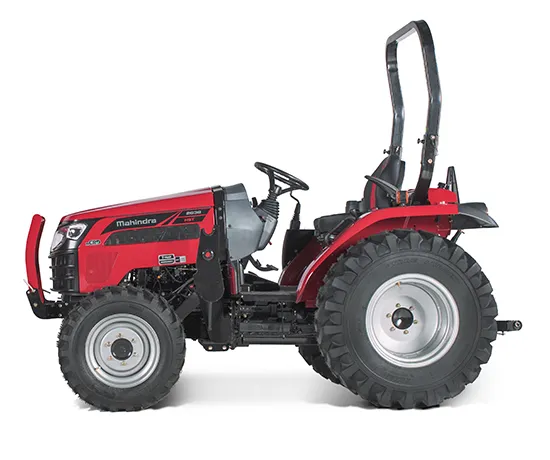
Best for 10-20 acres general work
Best for loader-heavy work
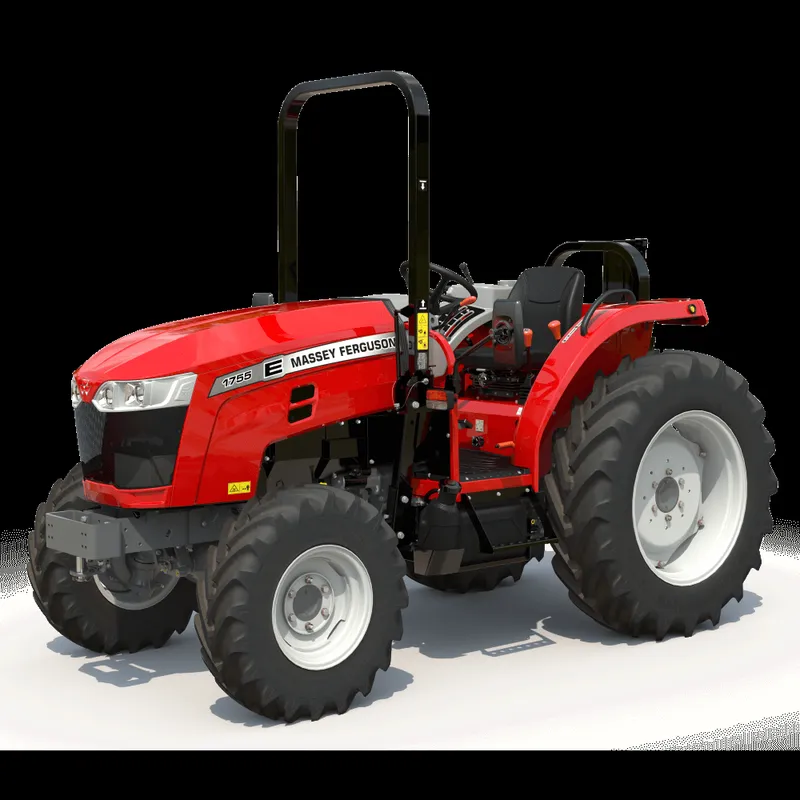
Best for mowing + pasture maintenance
Best for heavy 3-point implements
Best value
Best for slopes
Answer a few questions about your property and tasks to get a personalized HP, PTO, hydraulics, and attachment recommendation.
A utility tractor is a mid-size tractor typically in the 25-135 engine horsepower class, designed for property owners and farmers managing 5-50+ acres. Utility tractors bridge the gap between compact tractors (25-50 hp) and full-size row-crop/agricultural tractors. They handle heavier loader work, wider mowing implements, serious ground engagement, material handling, and moderate agricultural tasks that compacts cannot efficiently perform.
For 10 acres with mixed tasks (mowing, loader work, driveway maintenance, light tilling), a utility tractor in the 25-50 HP range is a solid starting point. If your 10 acres includes slopes, clay soil, or heavy brush cutting, consider moving to the 45-66 HP range to ensure you have adequate reserve power and implement capability.
For 20 acres with regular loader use, pasture mowing, and ground engagement tasks, aim for 45-66 HP. This range supports 5-6 foot rotary cutters, box blades, rear tillers, and capable front-end loaders. If your 20 acres includes heavy brush, frequent hauling, or steep terrain, look at 66-80 HP models for comfortable reserve power.
For 50 acres, especially with regular implement use and heavy loader tasks, target 66-135 HP. This range allows you to run 7-foot or wider rotary cutters, larger tillers, and heavier 3-point implements efficiently. The higher end is appropriate if you plan to use hay equipment, large augers, or run implements that demand continuous high PTO horsepower.
4WD is strongly recommended for virtually all utility tractor use. The added traction is critical for loader work, grading, operating on slopes, wet conditions, and snow removal. At the utility class weight and horsepower level, the stability and traction benefits of 4WD are significant. Very few modern utility tractors are sold without 4WD.
A 5-foot rotary cutter needs approximately 25-35 PTO HP for grass and moderate brush. A 6-foot rotary cutter needs 35-50 PTO HP. A 7-foot cutter needs 45-65 PTO HP. Always add a 10-15% margin above the implement manufacturer's minimum PTO HP requirement to avoid straining the tractor during heavy cutting.
To operate a grapple bucket effectively, you need at least 8-12 GPM of hydraulic flow and a third-function hydraulic valve (or dedicated auxiliary circuit). Higher GPM (12-18+) provides faster grapple open/close speed and more responsive loader cycles. Check that the tractor has at least 2 remote hydraulic valves, ideally 3, for grapple and top-n-tilt capability.
Hydrostatic (HST) transmissions use a hydraulic pump and motor for infinite speed control via foot pedals, making them ideal for loader work, snow removal, and frequent direction changes. Gear or power-shuttle transmissions use mechanical gears (with a powered forward/reverse shuttle) for more efficient power transfer during steady PTO work like tilling, mowing, and pulling. HST is generally preferred for versatility; gear/shuttle for fuel efficiency and heavy pull work.
Both are valid options. New utility tractors offer full manufacturer warranty (typically 2-6 years powertrain), known maintenance history, current emission compliance, and dealer financing. Used utility tractors cost 30-50% less but require disciplined inspection of hours, hydraulics, PTO function, frame/loader condition, and maintenance records. Dealer-certified used units offer a middle ground.
Walk-away red flags include: milky engine oil (coolant contamination), hydraulic systems that drift (loader or 3-point drops when holding position), frame or loader cracks with amateur weld repairs, PTO that will not engage or makes grinding sounds, disconnected or tampered hour meter, excessive blue smoke on cold start, and no maintenance records on a high-hour machine.
Annual maintenance costs for a utility tractor vary by use intensity. Light use (under 200 hours/year) typically costs $300-$800 in routine maintenance (oil, filters, fluids). Moderate use (200-500 hours) costs $800-$1,500. Heavy use (500+ hours) can run $1,500-$3,000+. These are DIY ranges; dealer service adds a labor premium. Budget separately for tire replacement, hydraulic hose repairs, and major service intervals.
Common repair ranges (parts + labor, vary by model): hydraulic hose replacement $100-$300, hydraulic pump rebuild $800-$2,500, PTO clutch replacement $500-$1,500, transmission overhaul $2,000-$6,000+, engine overhaul $3,000-$8,000+, loader cylinder reseal $200-$600. Proactive maintenance significantly reduces the probability and severity of major repairs.
Dealer support is a top-3 buying factor because tractors are working machines that need timely parts and service. A strong dealer network means faster parts availability, shorter service turnaround, local warranty support, and knowledgeable technicians familiar with your specific model. A great tractor from a brand with no nearby dealer can mean expensive downtime during critical seasons.
Cab tractors feature an enclosed operator station with heat, air conditioning, reduced noise, and protection from dust and weather. Open station tractors have a Roll-Over Protective Structure (ROPS) but no enclosure. Cabs add $5,000-$15,000+ to the price and 500-1,000 lbs of weight. Choose a cab if you operate in extreme heat, cold, or dusty conditions regularly. Open station is lighter and more affordable for moderate-weather use.
R4 industrial tires are the best all-around choice for utility tractors used in mixed loader, grading, and mowing work. They provide good traction on gravel, dirt, and mild slopes without excessive lawn damage. Turf tires minimize lawn damage but sacrifice traction on slopes and loose surfaces. Ag (R1) tires provide maximum field traction for heavy ground engagement but damage lawns significantly.
Ballast a utility tractor by adding weight to the rear to counterbalance the front-end loader. Common methods: attach a heavy 3-point implement (box blade, ballast box), fill rear tires with fluid (calcium chloride, beet juice, RimGuard), or use a dedicated ballast box with steel or concrete. The rear axle should carry at least 40% of total machine weight when the loader is fully raised. Always keep the loader low when traveling.
Category I hitches use smaller pins and are standard on sub-compact and smaller compact tractors, supporting implements up to approximately 2,000 lbs. Category II hitches use larger pins and are standard on utility tractors, supporting heavier implements. Many utility tractors offer Cat I/II combination hitches that accept both sizes with bushings, providing maximum implement compatibility.
Consider moving up from a compact (25-50 hp) to a utility tractor if you: manage 20+ acres with regular implement use, need to run implements requiring 40+ PTO HP (large rotary cutters, heavy tillers, hay equipment), move heavy materials frequently with a loader, work in tough soil conditions that demand more weight and power, or need a cab for comfort during long operating days.
Part of the Tractor Iron Home editorial guide series.
Specs, pricing and real-world guidance for tractor buyers and owners.
© 2026 Tractor Iron. All rights reserved.